Crime Scene Reconstruction: From Traces to Events
Reconstruction works backwards from traces to possible events. Six sections examine validation, physical assumptions, measurement uncertainty, contextual bias, conclusion language and documented failures.
A broad practice without a broad validation study
On 19 April 1989, an explosion in the number-two gun turret of the USS Iowa killed 47 sailors. The FBI used equivocal death analysis to infer the state of mind of Gunner's Mate Clayton Hartwig and concluded, with what later reviewers described as absolute rather than probabilistic certainty, that he deliberately caused the blast. One agent recalled that only three of 45 analyses had been inconclusive.
The House Armed Services Committee asked fourteen independent experts to review the work; ten considered it invalid. Poythress et al. reported in American Psychologist in 1993 that the committee regarded the analysis as an investigative failure and that the FBI had failed peer review. Poythress also found no published reliability or validity studies of equivocal death analysis. Sandia National Laboratories later identified physical evidence supporting an accidental cause, and the Navy reopened the matter.
Reconstruction as a whole has not been subjected to a black-box study with known event histories and measured error rates. Chisum and Turvey's Crime Reconstruction says that little scientific research has examined reconstruction as a process, that no universal principles have been articulated and that it is among the least understood forensic procedures. It describes Locard's exchange principle as an axiom accepted without proof.
Some reconstruction claims rest mainly on practitioner experience. Hazelwood and Napier's 2004 account of crime-scene staging used a telephone survey of twenty law-enforcement officers known to the authors, who estimated cases from memory. The authors said that documented staging statistics were unavailable and that the results should not be generalised. Those limits should accompany any reliance on the study.
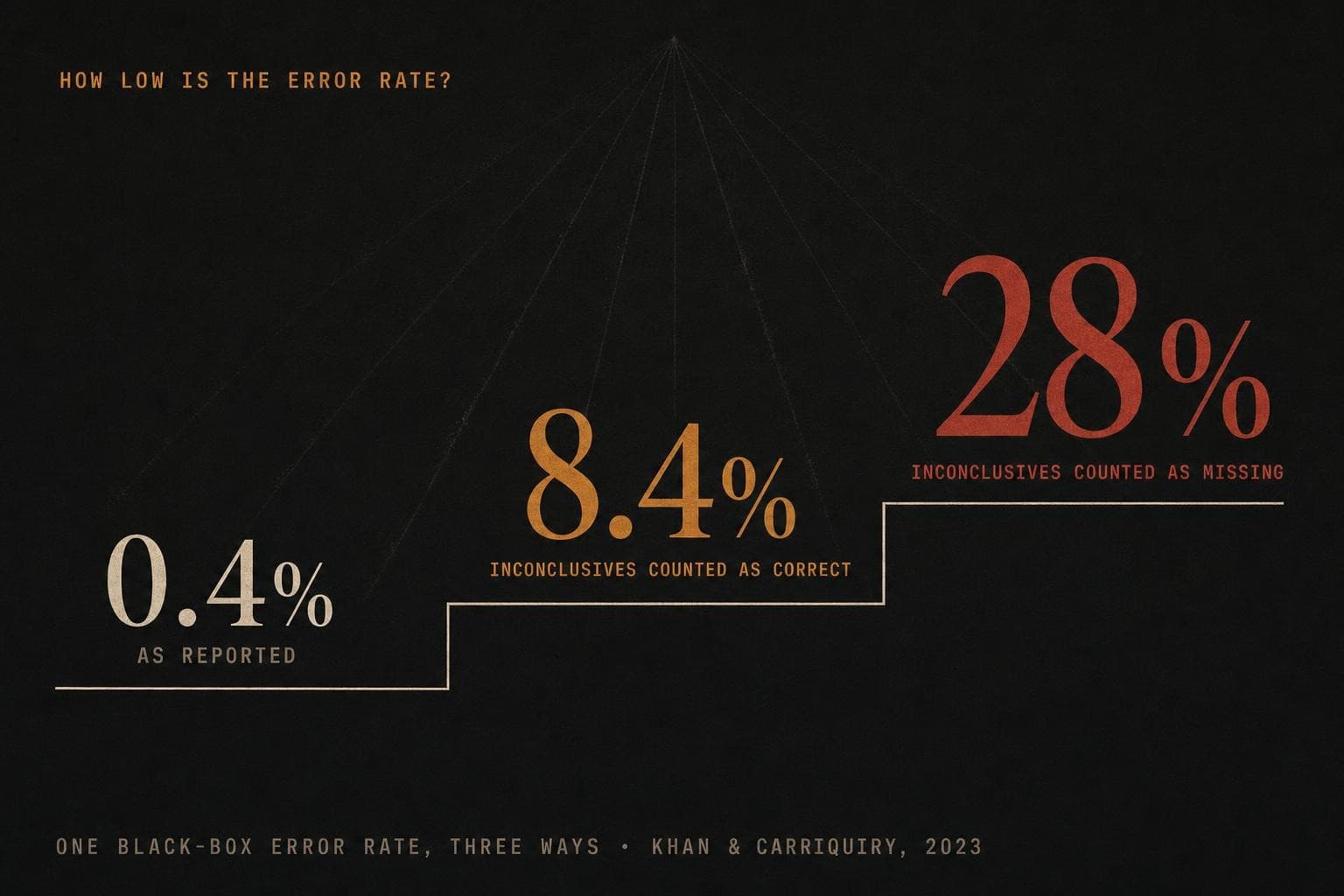
Black-box studies also require scrutiny. Khan and Carriquiry (2023) note self-selected participants and non-response on difficult comparisons. In their analysis, a reported error rate "as low as 0.4%" became at least 8.4% when inconclusive responses were treated as correct and above 28% when treated as missing. The existence of a study therefore does not resolve design and counting questions. For much of reconstruction, no comparable study exists.
“There have been no published studies of the reliability or validity of EDA.”
Where is the error rate?
Counsel accepts your experience, then asks the one question the discipline struggles to answer.
"I put it to you that there is not a single published study measuring how often reconstructions like yours reach the correct answer where the truth is independently known. Your method has no established error rate at all, does it?"
The physics you can't skip
Reconstruction infers causes from physical effects, including bullet paths, droplet flight and wound-related spatter. A diagram may use straight lines even when the underlying trajectory was affected by impact, drag or gravity.
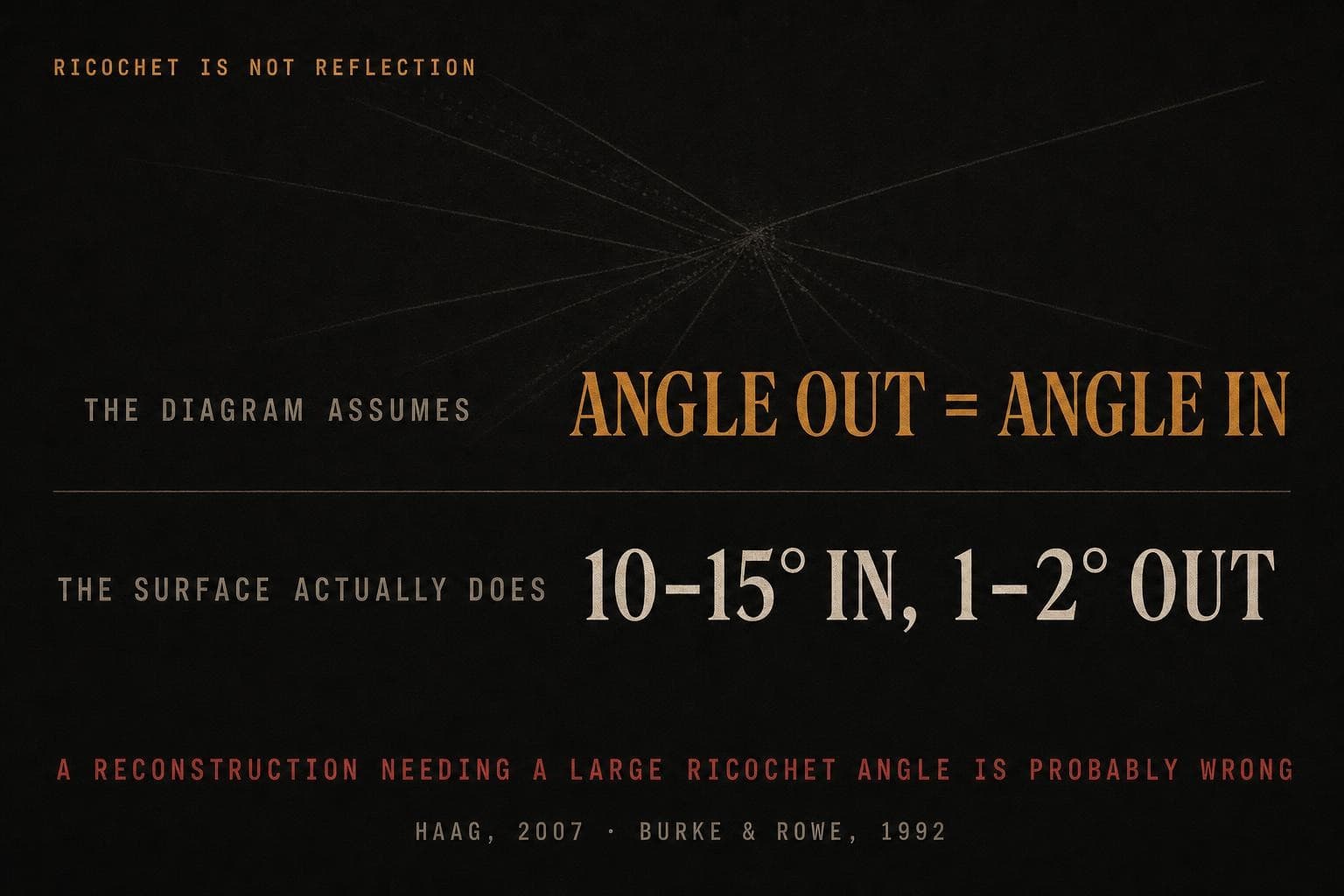
Burke and Rowe's 1992 review found that bullet ricochet angles are usually much smaller than incidence angles and commonly only a few degrees. Haag reported bullets striking concrete at 5°, 10° or 15° leaving at 1° to 2°, and a 9 mm bullet striking steel at 10° leaving at 1.4°. Burke cautioned that a reconstruction requiring a large ricochet angle is probably wrong.
Intermediate targets also deflect bullets. Nishshanka et al. found in 2021 that rifle-round deflection through sheet metal increased as incidence angle fell, reaching several degrees below 40°. Below about 20°, fragmentation produced secondary marks. Mattijssen's 2018 particle-board study found peak deflection near a critical angle; a .32 round arriving at 18° left 12° off line. Haag showed that a tumbling bullet may be nose-forward during part of its cycle and leave a round entrance, so wound shape alone does not prove a direct path. Nishshanka later observed shallow-angle concrete ricochets producing nose-forward impacts resembling orthogonal hits.
Blood droplets are affected by gravity and drag. Straight-line stringing may place the origin too high. Attinger et al. reported in 2019 that the possible origin region grows approximately with the fifth power of distance, from about 0.1 litre near the wall to 95 litres for a slow impact just over one metre away. Schyma's 2020 high-speed study of 102 shots found backspatter jets during collapse of the temporary wound cavity, not penetration, with stochastic deviation around 13° despite the same firearm and ammunition.
“It must be kept in mind that angles of ricochet are usually quite small (typically only a few degrees). If a reconstruction requires a large angle of ricochet, it is probably wrong.”
The straight line through the door
Your diagram shows a straight line from the firing position through a door panel to the wall. Counsel stands at the door.
"I put it to you that once this bullet passed through the door it did not carry on in a straight line. A bullet that strikes an intermediate surface deflects, and at a shallow angle that deflection can be ten degrees or more. Your line assumes a straight path the physics doesn't support, doesn't it?"
Every measurement carries an error bar
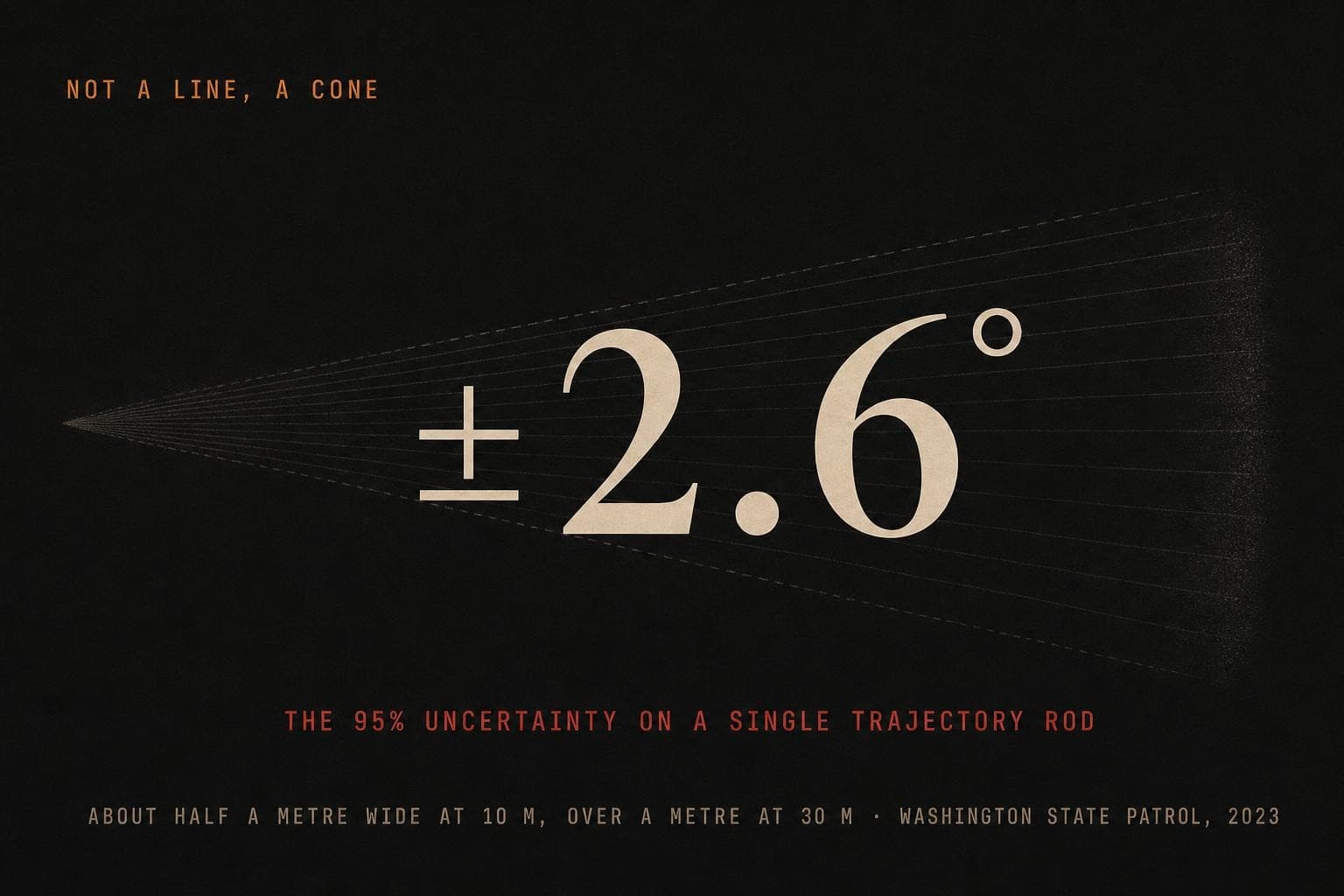
Even a tested measurement carries uncertainty. A Washington State Patrol team reported in 2023 an overall uncertainty of ±2.6° at approximately 95% confidence for trajectory angles measured with rods. They recommended a 2.6° cone around each rod in a diagram. That cone is about half a metre wide at ten metres and more than one metre wide at thirty. The figure covers measurement of the rod only. Whether the rod represents the bullet's earlier path after deflection and drop is a separate question.
Walters and Liscio tested the 2D ellipse method on 220 impacts with 31 analysts in 2020. It performed well at shallow angles but poorly near perpendicular, where a 1 mm marking error could produce a 17° angle error. Keldson and Liscio found errors from 1° to 13.9° when estimating shooter position from car-door bullet holes, with calibre-specific error curves. Riva et al. reconstructed shooting geometry from body scans in 2021. Standing postures produced errors of a few degrees, but assuming the person was leaning when he was in fact sitting upright produced mean error of 15.8° and could reverse the inferred direction.
Base rates also matter. Keppel and Weis reviewed 5,224 Washington State murders from 1981 to 2000 and found six staged scenes, about 0.1%, and fourteen posed bodies. Most investigators may never encounter a staged homicide. Krywanczyk and Shapiro found statistical differences between homicide and suicide blade wounds but no wound characteristic that was definitive; every feature favouring homicide had also appeared in a documented suicide.
“Only 1.3% of victims are left in an unusual position, with 0.3% being posed and 0.1% being staged.”
The cone the jury never saw
You gave the jury a firing position thirty metres back. Counsel asks what the give-or-take is.
"You drew a straight line back to where my client stood, thirty metres away. Your own field puts a give-or-take of a couple of degrees on that rod, and at thirty metres that cone is wider than a car. So it takes in the doorway next door just as easily, doesn't it?"
The examiner is part of the instrument
Reconstruction often requires integrating statements, suspect information and findings from other disciplines. That breadth also creates opportunities for contextual information to influence judgement.
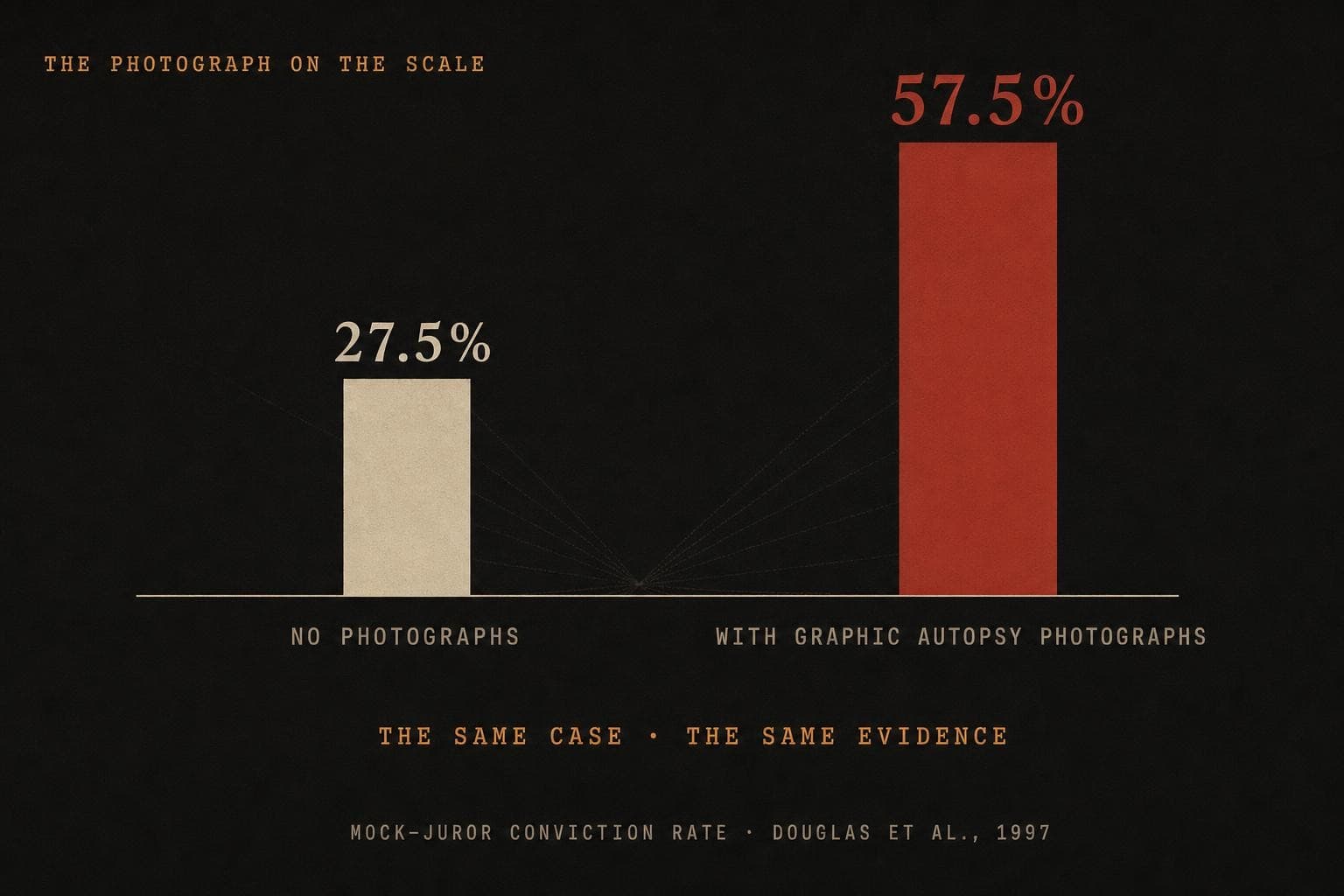
Douglas et al. presented mock jurors with the same case but varied autopsy photographs. Conviction rates were 57.5% with colour photographs and 27.5% without them, while participants rated their impartiality similarly. Jobes et al. gave 195 medical examiners equivocal deaths and added a psychological narrative for half. The narrative changed manner-of-death decisions in four of five cases; in one, nearly 90% moved towards suicide. Kassin and Dunn found that a partisan animation led most viewers to call a fall accidental even though a landing 20–25 feet from the building conflicted with the displayed physics.
Van den Eeden and colleagues gave experienced scene investigators an ambiguous mock scene after telling them it involved suicide, murder or no stated hypothesis. The prior affected first impressions and the traces collected, although similar traces were physically available. A 2019 comparison found no evidence that experts outperformed novices. Lidén and Almazrouei reported two similarly experienced investigators collecting 15 and 38 samples from the same scene, with case theory influencing search decisions.
Edmond et al. call the downstream effect the biasing snowball. An opinion influenced by the case theory may later be treated as independent corroboration of that same theory. Case management and sequenced information exposure can reduce this circularity by documenting physical observations before broader theories are introduced. Awareness alone is not an adequate control.
“The present study provides no evidence that professional experts outperform novices.”
What you knew before you looked
Counsel asks, quietly, what you had already been told before you formed your view.
"Before you formed any view about what happened in that room, you had already read the detectives' theory of the case and knew who they suspected. You've told the jury your reconstruction independently corroborates their account. But you were told that account before you started, so how is it independent, rather than the same story reaching the court twice?"
Saying it like evidence, not like certainty
The phrase "consistent with" does not say how many alternative accounts are also consistent. Neumann et al. wrote in CHANCE in 2016 that the expression may be understood anywhere between "all others excluded" and "worthless."
A likelihood ratio instead compares the probability of the observations under two stated event propositions without giving the probability of either proposition. Evett et al. showed in 2002 why the level of proposition matters. In one worked case, effectively conclusive source-level evidence about whose DNA was present produced an activity-level LR of around a thousand for how it came to be there, orders of magnitude short of the source-level match. Source and activity questions require separate evaluation.
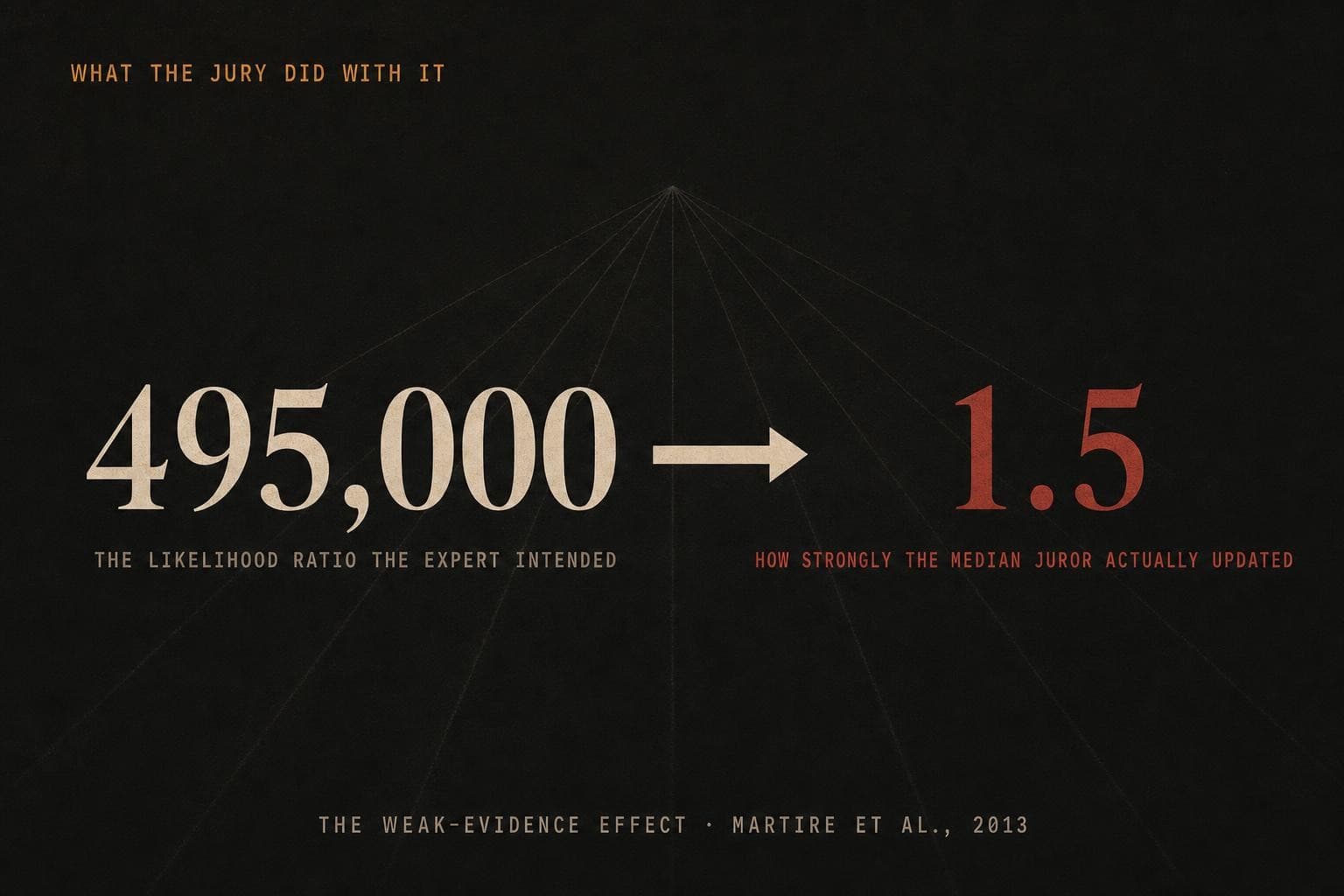
Martire et al. found a weak-evidence effect in how lay participants interpreted evaluative opinions. When an expert intended an LR of 495,000, the median participant updated as though it were 1.5. The lowest verbal category, "weak support," led many to treat prosecution evidence as favouring the defence. De Keijser and Elffers found that 92.4% of judges, 80.9% of defence lawyers and 58.2% of forensic experts endorsed a transposed conditional, while 85% of experts believed they understood the reports almost perfectly.
The 2025 OSAC terminology standard for shooting reconstruction defines 89 terms concerning angle, ricochet, trajectory and directionality, but does not provide a method for expressing uncertainty, probability or evidential strength. Any use of "consistent with" therefore needs an explanation of the alternatives and degree of support.
“Where the expert indicated a likelihood ratio of 495,000 should be applied, the median participant response was to update their beliefs using a likelihood ratio of just 1.5.”
Reconstruction conclusions fail most often in the wording, not the measuring. Each phrase below claims more than the scene supports; the alternative keeps the sentence inside what was actually measured and hands the court a denominator.
Consistent with what else?
You told the jury the pattern is consistent with the prosecution's account. Counsel asks what else it fits.
"You told the jury this pattern is consistent with my client standing where the prosecution says he stood. How many other positions in that room would also be consistent with it? And is it not just as consistent with my client's own account of what happened?"
When reconstruction failed
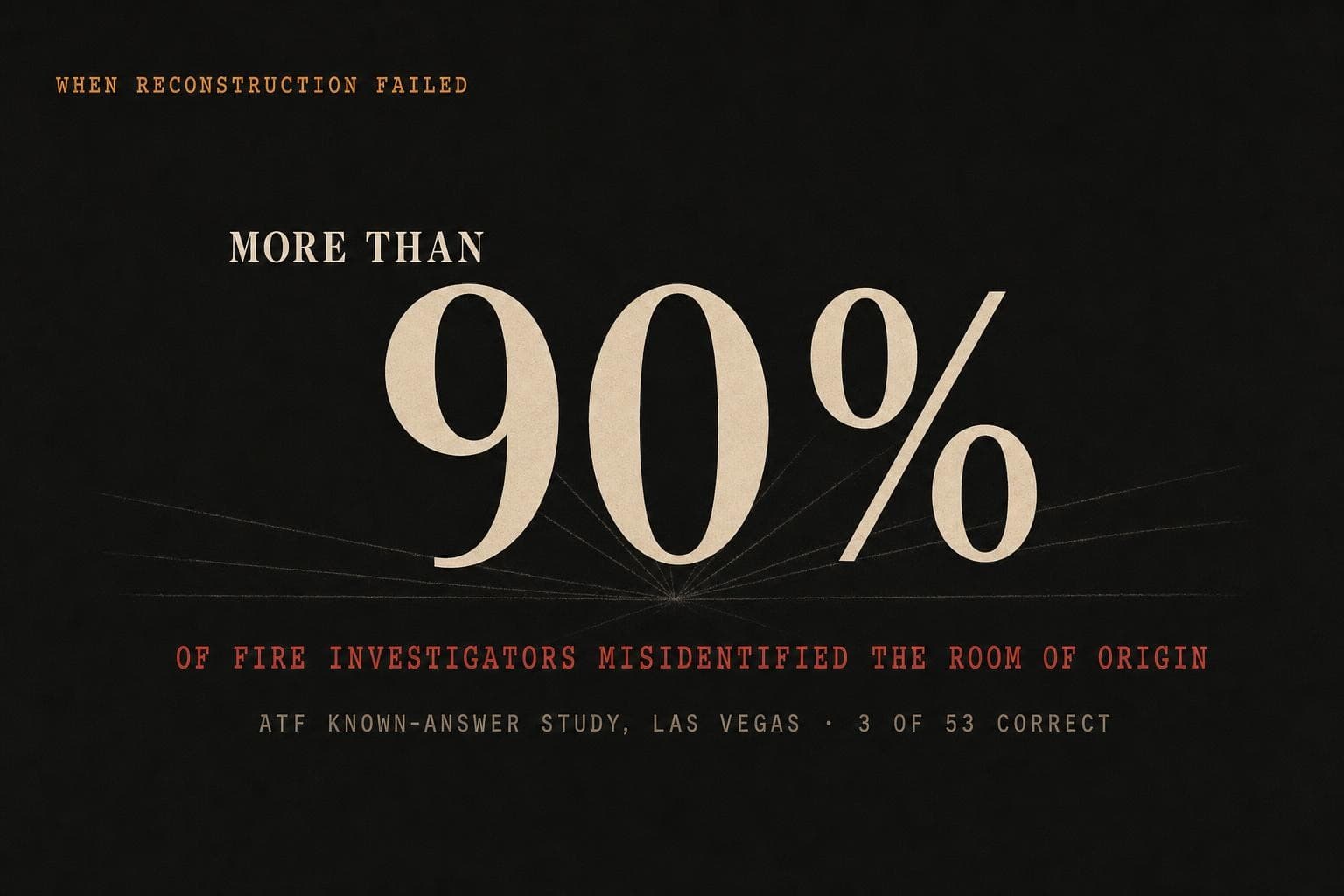
Documented failures include the USS Iowa analysis and earlier fire-scene methods that treated "pour patterns" and "crazed glass" as proof of arson. In an ATF known-answer study in Las Vegas, three of 53 investigators correctly identified the origin quadrant in both rooms, an error rate above 90%. A 2007 Oklahoma City repeat was about 25% correct, no better than chance.
John Lentini documented the cases of Ernest Ray Willis, who spent seventeen years on death row, and Cameron Todd Willingham, who was executed. A later state expert said the fire evidence was more characteristic of mysticism than science. In Willingham's case, the deputy fire marshal relied on twenty arson indicators later found invalid or explained by flashover, and testified, as Giannelli records, that the fire told him the truth.
John Morgan's 2023 Journal of Forensic Sciences study coded 732 wrongful convictions associated with false or misleading forensic evidence, covering 1,391 examinations. Testimony errors appeared in 376 cases and errors by officers of the court in 519. Morgan estimated that improved technology, testimony standards or practice standards available at trial could have prevented about half of the convictions. Incorrect source attribution was less common than misleading expression and use of the evidence.
The New South Wales Court of Criminal Appeal quashed Gordon Wood's murder conviction in 2012. A physicist had reconstructed a "spear throw" from a cliff using daylight experiments with cooperative volunteers on safe ground. The court found opinions outside his expertise, unsophisticated experiments, a clearly wrong assumption and active participation in making evidence. It reiterated that speculation, conjecture and suspicion cannot establish proof beyond reasonable doubt. A defensible reconstruction ties conclusions to documented physical evidence, states assumptions and uncertainty, uses undetermined when support is insufficient, and remains within the examiner's expertise.
“Speculation, conjecture and suspicion can never amount to proof beyond reasonable doubt.”
- 01Reconstruction as a whole has never been validated by a black-box study. If you are asked for your method's error rate and there is none, say so; do not offer years of experience or courtroom acceptance in its place.
- 02The physics sets hard limits. Ricochet angle does not mirror incidence, a bullet deflects through an intermediate surface, a tumbled bullet leaves a normal wound, and blood falls on a curve. Do not draw a straight line that assumes none of this.
- 03Every measurement carries an error bar, usually wider than the number sounds. Report the cone, not the point, and remember a small angular error becomes a large positional one down range.
- 04Base rates discipline the rare claims. Staging is about one death scene in a thousand, and no blade wound is definitive for homicide over suicide. Begin those opinions from the base rate, not from the case theory.
- 05You are exposed to context by design, and experience does not lift it. An opinion shaped by the case theory is not independent corroboration of it. Point to a procedure that kept the irrelevant context out, not to your own objectivity.
- 06"Consistent with" hides its denominator. Say how much more probable the pattern is under one account than another, name both accounts, and never state the probability of the account itself. That belongs to the court.
- 07The failure cases are the cross-examiner's source material. Tie every conclusion to physical evidence, disclose your assumptions, return "undetermined" honestly, and stay inside your qualified field.
Inside your field, or past it?
Your reconstruction is offered as physics, carrying the authority of science. Counsel tests where the physics ends.
"Your opinion relies on physics, but part of the conclusion concerns how a person moved and behaved under stress. Which parts fall within your qualified expertise, and which are inferences from other fields?"
Still have questions about the research?
Ask anything about the crime scene reconstruction literature. The tutor answers from the document itself — and keeps one eye on how it might come up under cross-examination.
- Morgan, J. (2023). Wrongful convictions and claims of false or misleading forensic evidence. Journal of Forensic Sciences, 68(3), 908–961.
- Poythress, N., Otto, R. K., Darkes, J., & Starr, L. (1993). APA’s expert panel in the congressional review of the USS Iowa incident. American Psychologist, 48(1), 8–15.
- Hazelwood, R. R., & Napier, M. R. (2004). Crime scene staging and its detection. International Journal of Offender Therapy and Comparative Criminology, 48(6), 744–759.
- Khan, K., & Carriquiry, A. (2023). Hierarchical Bayesian non-response models for error rates in forensic black-box studies. Philosophical Transactions of the Royal Society A, 381, 20220157.
- Burke, T. W., & Rowe, W. F. (1992). Bullet ricochet: A comprehensive review. Journal of Forensic Sciences, 37(5), 1254–1260.
- Haag, L. C. (2007). Wound production by ricocheted and destabilized bullets. American Journal of Forensic Medicine and Pathology, 28(1), 4–12.
- Nishshanka, B., Shepherd, C., & Ariyarathna, R. (2021). AK bullet (7.62×39 mm) holes on 1-mm sheet metal. Journal of Forensic Sciences, 66, 1276–1284.
- Attinger, D., Comiskey, P. M., Yarin, A. L., & De Brabanter, K. (2019). Determining the region of origin of blood spatter patterns considering fluid dynamics and statistical uncertainties. Forensic Science International, 298, 323–331.
- Schyma, C., Baumann, F., Madea, B., & Gotsmy, W. (2020). Study of backspatter using high-speed video of experimental gunshots. Forensic Science, Medicine and Pathology, 17, 36–46.
- Greenwood, S. M., Paduch, C. D., & Allen, T. T. (2023). An evaluation of measurement uncertainty of trajectory angles using a 3D laser scanner. Journal of Forensic Sciences, 68(3), 828–838.
- Walters, M., & Liscio, E. (2020). The accuracy and repeatability of reconstructing single bullet impacts using the 2D ellipse method. Journal of Forensic Sciences, 65(4), 1120–1127.
- Keldson, M., & Liscio, E. (2024). Validation of the lead-in method in a practical shooting scenario. Journal of Forensic Sciences, 69, 1235–1245.
- Riva, F., Buck, U., et al. (2022). Error estimation on extracorporeal trajectory determination from body scans. International Journal of Legal Medicine, 136, 1057–1067.
- Keppel, R. D., & Weis, J. G. (2004). The rarity of “unusual” dispositions of victim bodies: Staging and posing. Journal of Forensic Sciences, 49(6), 1308–1312.
- Krywanczyk, A., & Shapiro, S. (2015). A retrospective study of blade wound characteristics in suicide and homicide. American Journal of Forensic Medicine and Pathology, 36(4), 305–310.
- Douglas, K. S., Lyon, D. R., & Ogloff, J. R. P. (1997). The impact of graphic photographic evidence on mock jurors’ decisions in a murder trial. Law and Human Behavior, 21(5), 485–501.
- Jobes, D. A., Berman, A. L., & Josselson, A. R. (1986). The impact of psychological autopsies on medical examiners’ determination of manner of death. Journal of Forensic Sciences, 31(1), 177–189.
- Kassin, S. M., & Dunn, M. A. (1997). Computer-animated displays and the jury: Facilitative and prejudicial effects. Law and Human Behavior, 21(3), 269–281.
- van den Eeden, C. A. J., de Poot, C. J., & van Koppen, P. J. (2019). The forensic confirmation bias: A comparison between experts and novices. Journal of Forensic Sciences, 64(1), 120–126.
- Edmond, G., et al. (2015). Contextual bias and cross-contamination in the forensic sciences. Law, Probability and Risk, 14(1), 1–25.
- Neumann, C., Kaye, D., Jackson, G., Reyna, V., & Ranadive, A. (2016). Presenting quantitative and qualitative information on forensic science evidence in the courtroom. CHANCE, 29(1), 37–43.
- Evett, I. W., Gill, P. D., Jackson, G., Whitaker, J., & Champod, C. (2002). Interpreting small quantities of DNA: The hierarchy of propositions and the use of Bayesian networks. Journal of Forensic Sciences, 47(3), 520–530.
- Martire, K. A., Kemp, R. I., & Newell, B. R. (2013). The psychology of interpreting expert evaluative opinions. Australian Journal of Forensic Sciences, 45(3), 305–314.
- de Keijser, J., & Elffers, H. (2012). Understanding of forensic expert reports by judges, defense lawyers and forensic professionals. Psychology, Crime & Law, 18(2), 191–207.
- Organization of Scientific Area Committees for Forensic Science. (2025). Standard terminology for shooting reconstruction (OSAC 2025-N-0003). National Institute of Standards and Technology.
- Lentini, J. J. (2012). The evolution of fire investigation and its impact on arson cases. Criminal Justice, 27(1), 12–17, 60–62.
- Giannelli, P. C. (2013). Junk science and the execution of an innocent man. N.Y.U. Journal of Law & Liberty, 7(2), 221–253.
- Wood v R [2012] NSWCCA 21 (New South Wales Court of Criminal Appeal).
- Chisum, W. J., & Turvey, B. E. (2011). Crime Reconstruction (2nd ed.). Academic Press.
Bloodstain Pattern Analysis: What Can the Pattern Support?
Counsel is briefed on this literature. Take it into the witness box and practise crime scene reconstruction.