Bloodstain Pattern Analysis: What Can the Pattern Support?
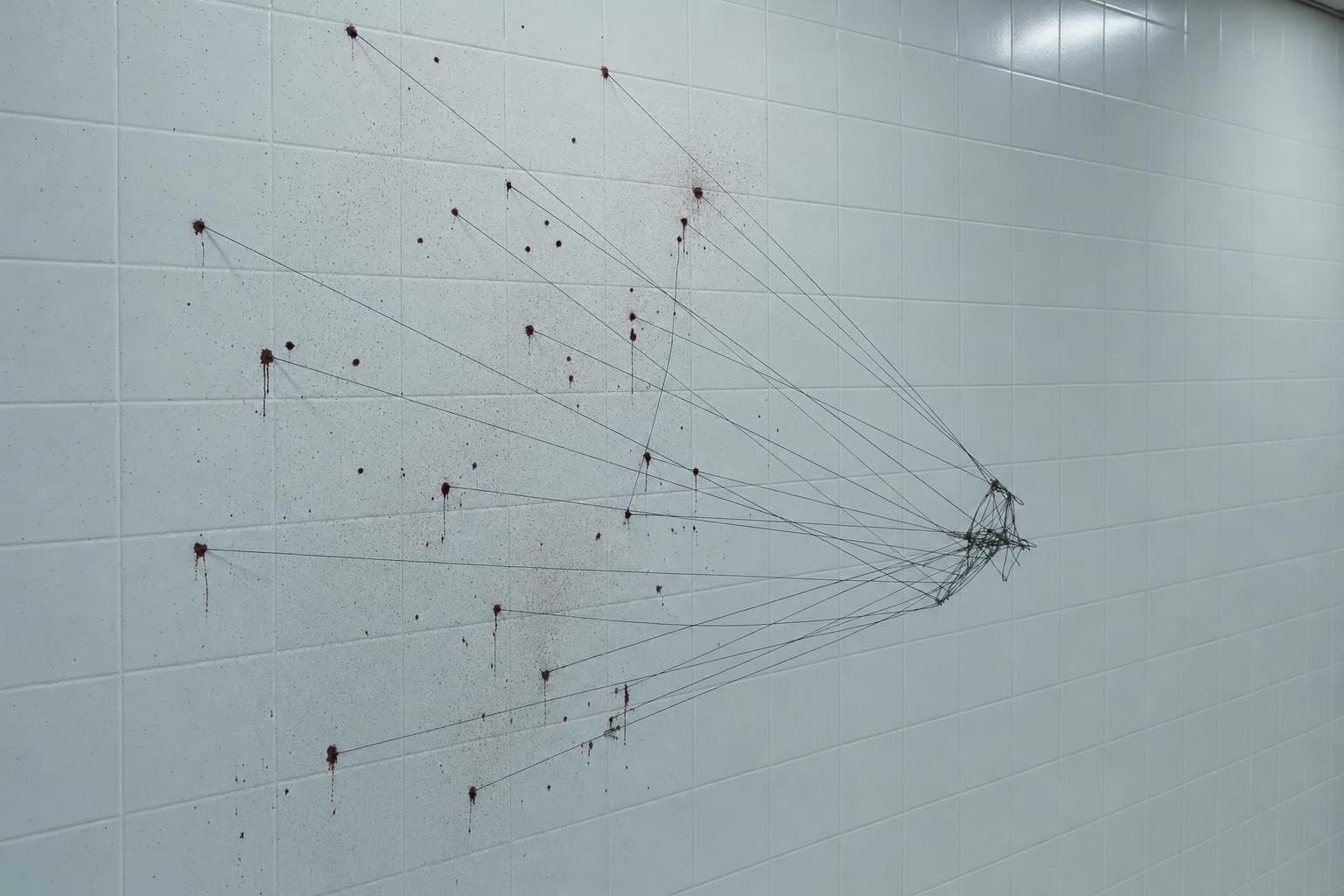
Bloodstain analysis reasons from stains to possible events. Six sections examine its late validation, measured disagreement, fluid dynamics, contextual bias, conclusion language and wrongful-conviction record.
Built at the scene, tested late
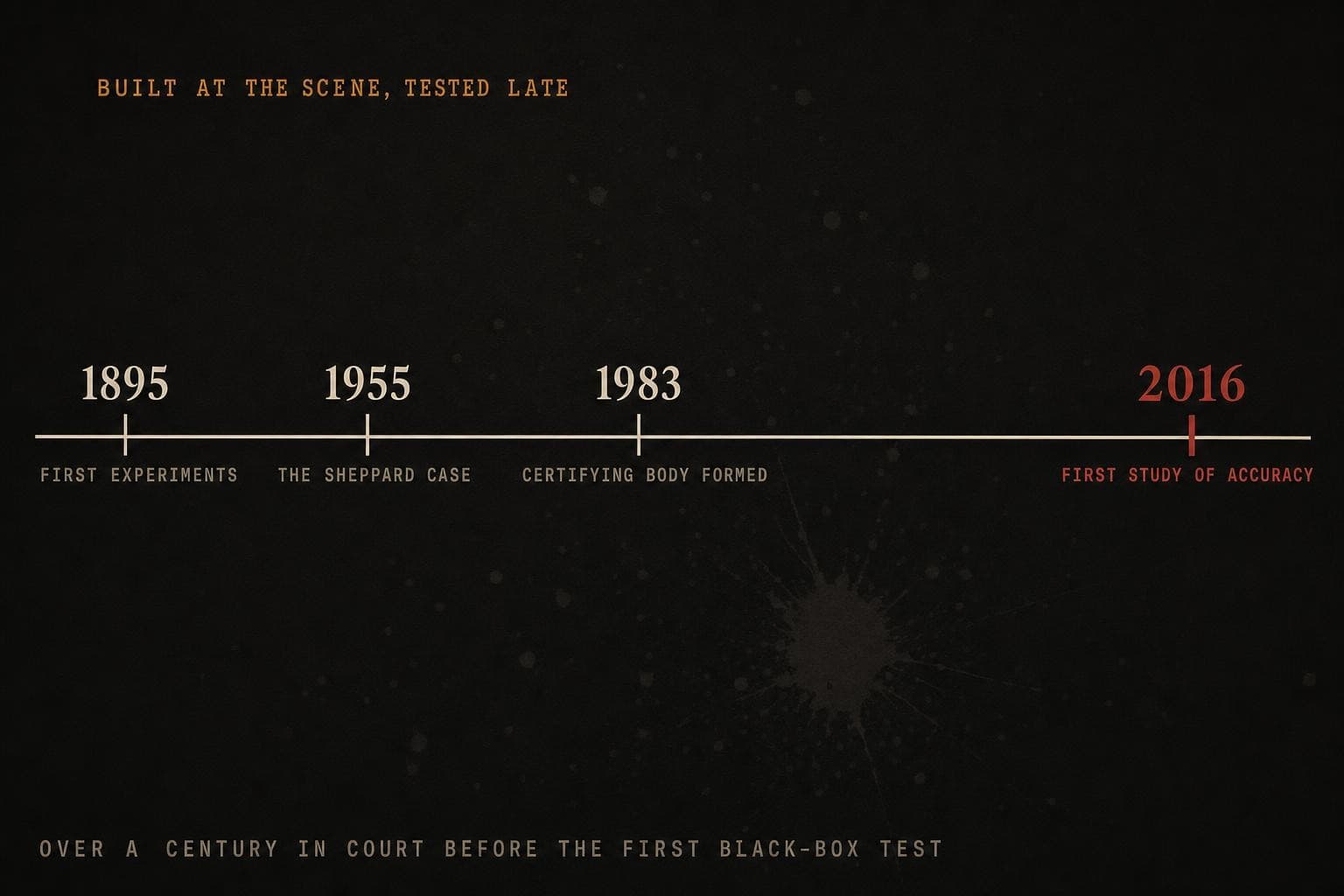
Bloodstain pattern analysis has a long history. Piotrowski published experiments in 1895, Kirk gave evidence in the Sam Sheppard case in 1955, MacDonell published a modern treatise in 1971 and began formal training in 1973, and the IABPA formed in 1983. The field nevertheless had no study measuring the accuracy of analysts classifying known patterns until black-box work began in 2016.
The 2009 National Academy of Sciences report said bloodstain opinions were generally more subjective than scientific and carried enormous uncertainty. It accepted that some broad distinctions may be possible, such as faster or slower spatter, but warned that some experts went beyond the available support. It also noted that the leading certifying body then imposed no educational requirement.
Standards do not all address accuracy. The ASB terminology document and its SWGSTAIN predecessor define labels such as impact and cast-off patterns. Hook et al. reported in 2024 that there was still no national or international classification method, but ten schemes across fourteen sources. Different analysts may therefore classify the same pattern differently. The authors also note that mechanistic labels name a cause before the sorting task is complete.
Different mechanisms may produce similar or indistinguishable patterns. Dror made that point in a 2023 keynote to IABPA. Coughing and impact, or dripping and impact, may leave overlapping appearances. A finding that a pattern is consistent with a beating has little value unless other mechanisms producing the same observations are evaluated. The former low-, medium- and high-velocity scheme was abandoned because stain-size ranges overlapped across mechanisms.
“In general, the opinions of bloodstain pattern analysts are more subjective than scientific.”
Standardised words, tested answers?
Counsel accepts that your terminology is standardised, then asks the harder question.
"Your discipline's terminology standard tells analysts which words to use, in reports and in this courtroom. Can you point me to the study establishing that an analyst who uses those standardised words actually classifies the pattern correctly?"
The black-box reckoning
Hicklin et al.'s 2021 NIJ-funded black-box study involved 75 practising analysts, 192 patterns with known causes and more than 33,000 responses. Analysts contradicted the known cause in 11.2% of responses. Among definite conclusions, about one in six was wrong.
Two analysts gave opposed answers on the same pattern in 7.8% of comparisons, and overall agreement was 54.6%. Some errors were shared, so agreement between analysts did not guarantee correctness. The authors concluded that analysts cannot always be expected to agree and may both be wrong when they do.
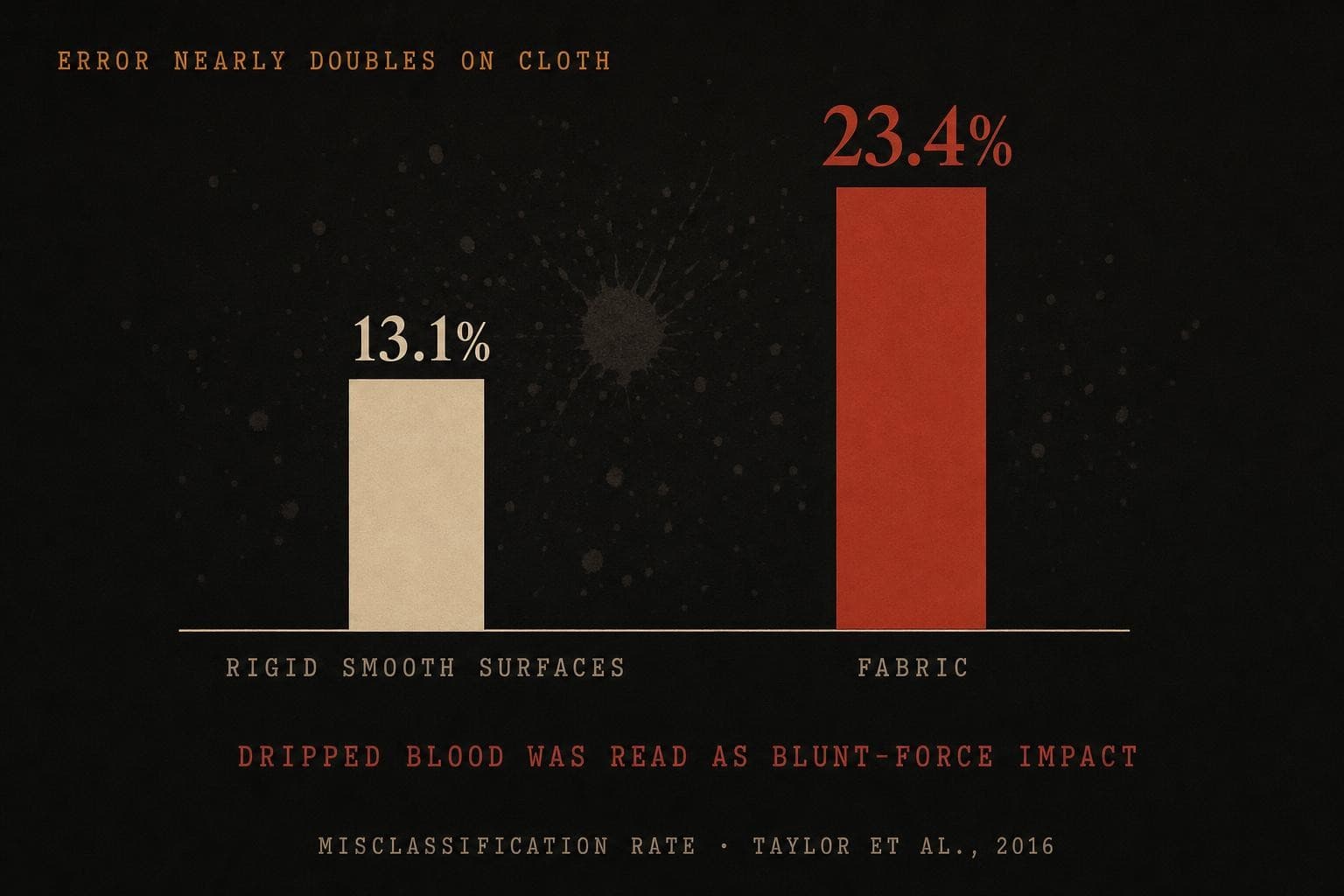
Taylor et al. examined surface effects. Experienced court-qualified analysts were wrong in 13.1% of classifications on rigid smooth surfaces and 23.4% on fabric. More than half of fabric errors involved satellite stains from dripping being interpreted as blunt-force impact; dripped blood was classified as an attack pattern in 85% of those examples. That distinction may affect whether blood on clothing is attributed to assault or assistance.
Expirated blood can also resemble fine impact or gunshot spatter. Geoghegan et al. found bubbles or beading in only 20% of expirated patterns and concluded that stain shape alone could not distinguish expiration from gunshot or impact. On fabric swipe patterns, Yuen et al. found analysts identified direction correctly in only 3% of cases.
“They cannot always be expected to agree, and if they do agree they may both be wrong.”
One in six, and the surface
The marks in this case are on clothing. Counsel opens the black-box study.
"A national study put bloodstain patterns with a known cause to seventy-five working analysts like you. Where they gave a definite answer, roughly one in six contradicted the true cause, and on clothing the error rate roughly doubled. Blood that had simply dripped was called an impact pattern more often than not. You cannot exclude an innocent explanation for these small stains, can you?"
Fluid dynamics sets the limits
Straight-line stringing assumes that droplets travelled without gravity or drag. In reality their paths curve, so the method tends to place an origin too high.
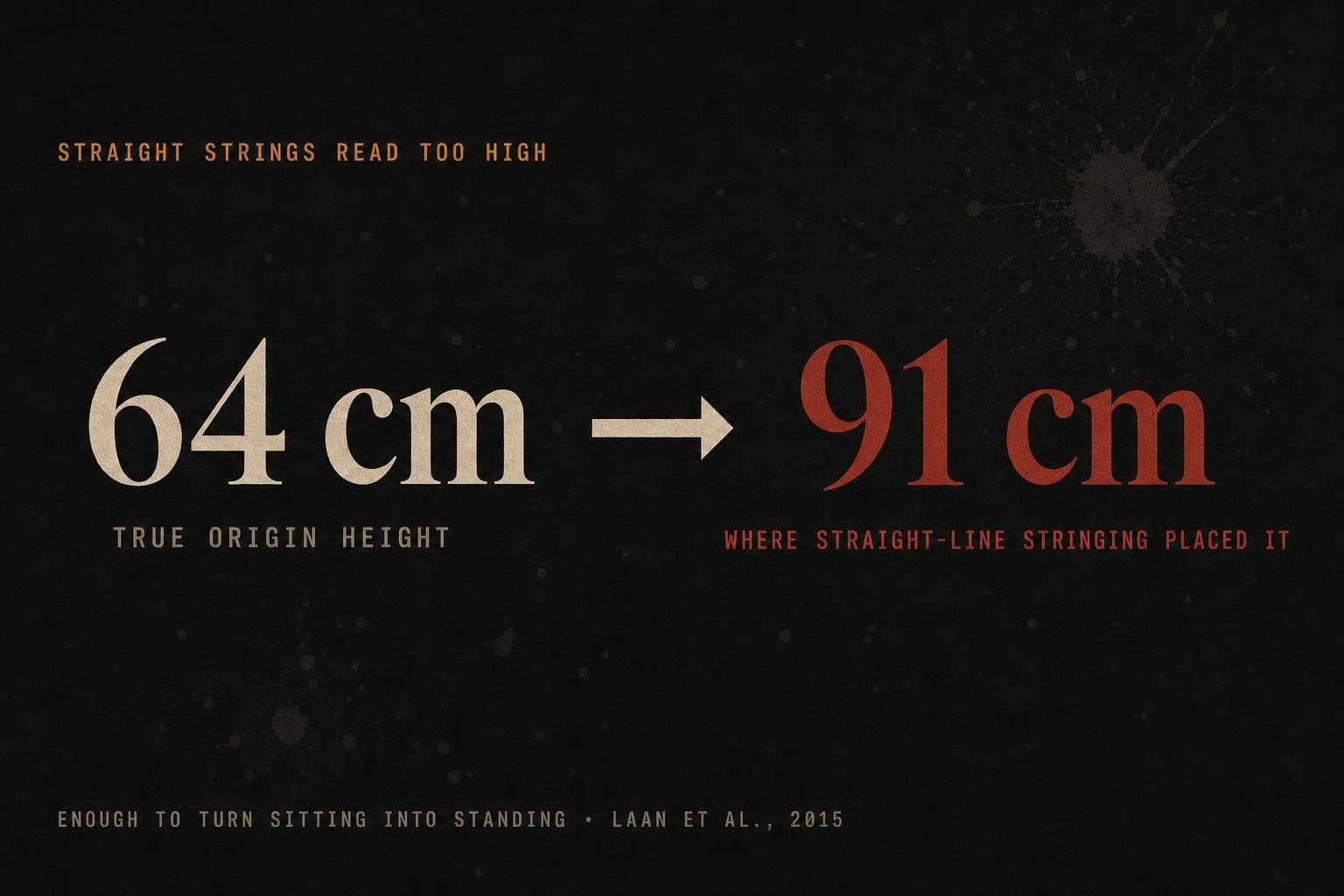
Behrooz et al. found straight-line triangulation overestimated known origin height by 50%. Laan et al. reported in 2015 that accounting for gravity and drag located the origin about four times more accurately; straight-line overstatement reached 45 cm, and one true height of 64 cm was estimated at 91 cm. Attinger noted that this may change an inference from sitting to standing. The physical source is also a region rather than a point because sheets and filaments break into droplets in flight. Attinger compared its possible size with a grapefruit or basketball.
The physics defines a useful but limited scope. Connolly et al. found that careful selection and averaging across stains reduced random angle error, and described straight-line directional analysis as valid and reliable within that scope. Kabaliuk et al. found minimal drag effect for a passively falling drop within about 1.5 m, a common indoor distance. Error increases with distance, height and velocity.
Classic stringing can therefore support broad regions and coarse distinctions rather than a precise point. It tends to overestimate height at greater distances. Stain size also cannot establish impact velocity because the former low-, medium- and high-velocity size categories overlapped across mechanisms.
“Straight-line triangulation resulted in a 50% height overestimation, whereas using the lowest calculated height for each spatter pattern reduced this error to 8%.”
Standing, or sitting?
You told the jury the victim was standing when struck. Counsel asks about the strings.
"You strung these stains back to a point and concluded that the victim was standing. Blood droplets follow curved paths under gravity and drag. Did you correct for that, and does the resulting uncertainty include a seated position?"
Context is part of the pattern
Bloodstain analysts may receive scene information, investigative theories and pathology findings before classification. Osborne et al. gave 39 trained analysts a cast-off pattern and allowed them to request case information and revise their decisions. Only four did not change any vote, all in the expert group. Medical findings caused nearly half of recorded reversals.
In observations of fifteen experienced analysts conducting casework, one was willing to classify a target pattern without context, while thirteen requested the pathology report. The studies show that case information is routinely integrated and may change classification.
Experience and awareness do not remove contextual effects. Edmond et al. call the downstream problem the biasing snowball: pathology information influences a bloodstain conclusion, which is then presented as independent corroboration of the pathology. The same information is effectively counted twice.
Osborne and Taylor trialled blind independent review in a laboratory. The second analyst worked without case information or the first conclusion. The two agreed in nine of ten cases. In the tenth, review identified a decision the first analyst accepted had been driven by case circumstances rather than the pattern. The procedure was inexpensive and well received. In court, the relevant evidence is whether blind review occurred, not an assurance that context was put aside.
“Only four analysts did not shift any votes across the task—all were in the expert group.”
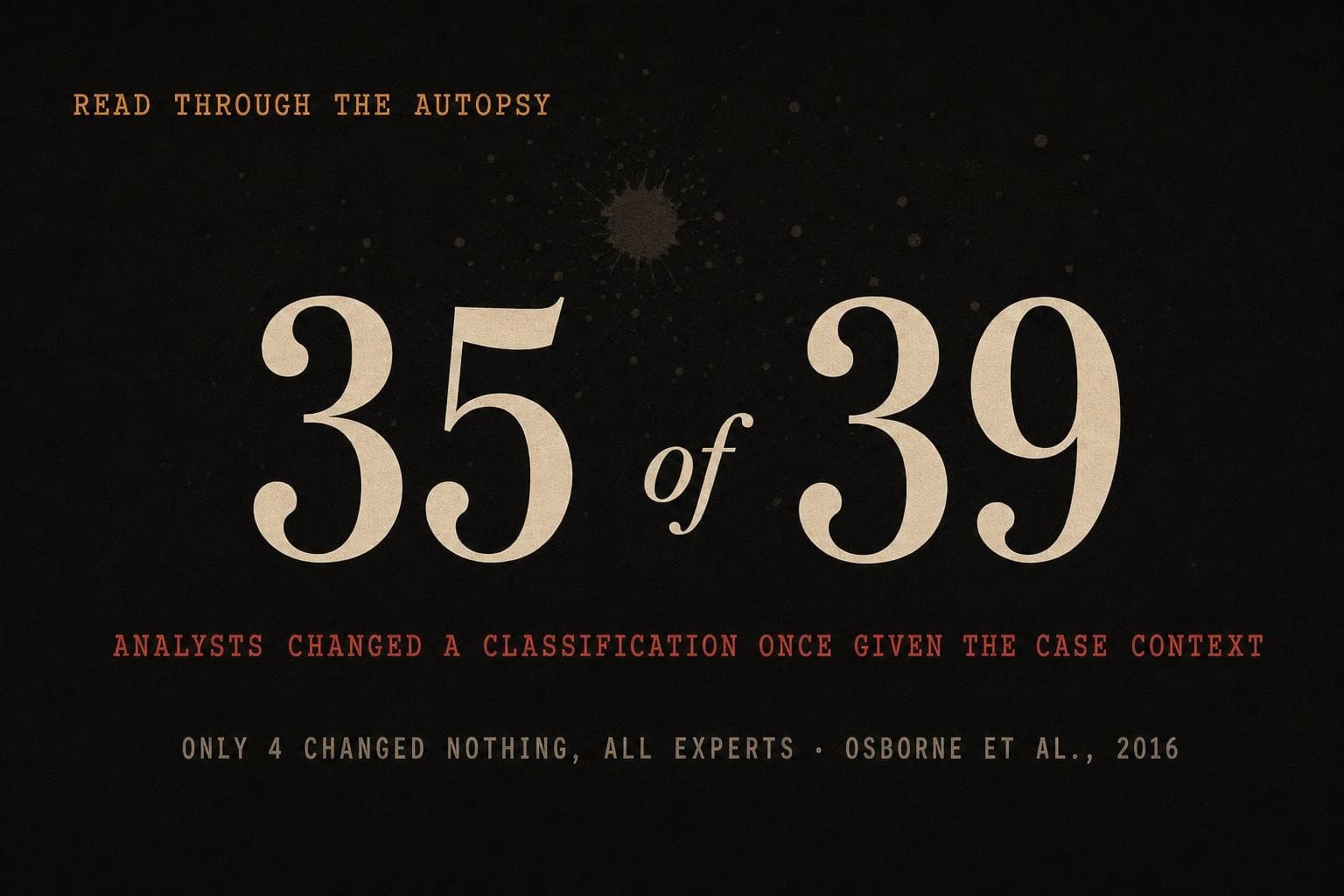
Read through the autopsy
Counsel asks what you had read before you wrote down what the pattern was.
"Before you classified this pattern as blunt-force impact, you had already read that the deceased died of blunt-force head injuries, hadn't you? So when the prosecution offers your bloodstain opinion as separate support for their theory, it isn't separate at all, it's the autopsy finding handed back to them in different words, is it not?"
Say it like evidence, not certainty
Conclusion language can overstate a properly performed classification. Garrett and Neufeld found invalid forensic testimony in 60% of DNA-exoneration cases they reviewed. Attinger et al. identify a recurring issue in BPA: analysts commonly report that a pattern is "consistent with" an account without weighing the strength of the observations. Quoting Evett, they say the phrase may suggest partiality or convey no assessment of evidential weight.
Bali et al. coded 500 forensic conclusions and found categorical statements in 70.6%, while information about reliability or validity was almost never included. A conclusion should therefore state the propositions, observations and limitations rather than rely on an undefined verbal category.
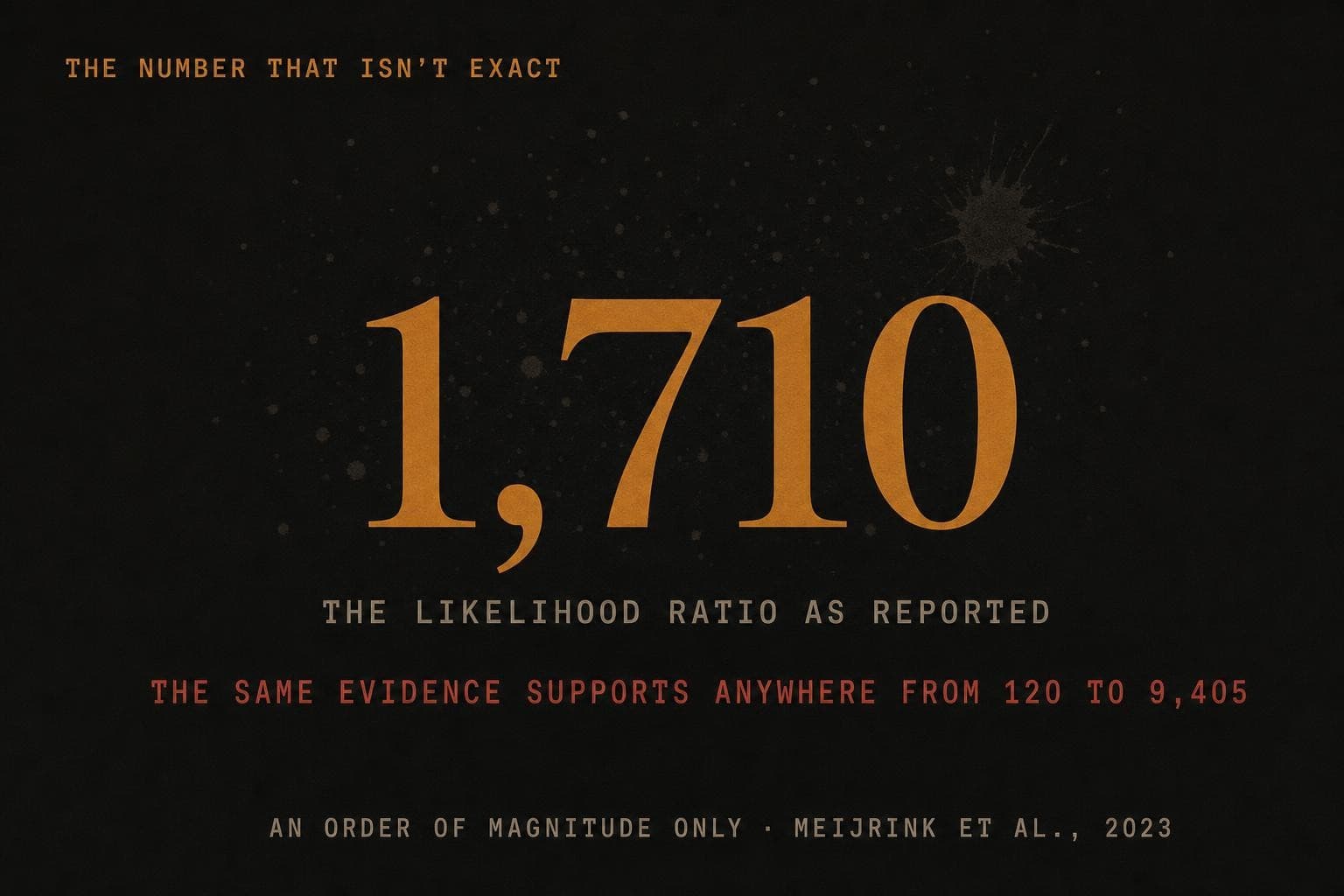
Meijrink et al. demonstrated a likelihood-ratio approach in a case comparing beating with expirated blood during CPR. Their overall LR was about 1,710 in favour of beating. Sensitivity analysis produced values from about 120 to 9,405 depending on judgement-based probabilities without calibration data. The authors warned that the point value implied unwarranted exactness and should indicate only an order of magnitude.
The OSAC methodology standard says opinions must not use unsupported data. It gives examples: inferring that an attacker was within two metres, a minimum volume of blood, or a time since bleeding from clotting. When stains are ambiguous, insufficient, altered or overlapping, the standard permits a conclusion that the pattern cannot be classified.
“The number suggests an exactness that is not warranted.”
Not everything a bloodstain analyst is asked to say rests on the same ground. The bars show how much settled scientific footing each kind of claim can draw on, from coarse description to the precise numbers the discipline's own standard warns against, not a real metric.
Point to the measurement
You told the jury the pattern shows a beating. Counsel opens your own methodology standard.
"You told the jury these stains are consistent with a beating. They're also consistent with your victim coughing blood while my client gave her CPR, aren't they? And your own methodology standard says you shall not state unsupported data. Point me to the measurement that lets you say this was a beating rather than something you cannot classify at all."
When patterns helped convict the innocent
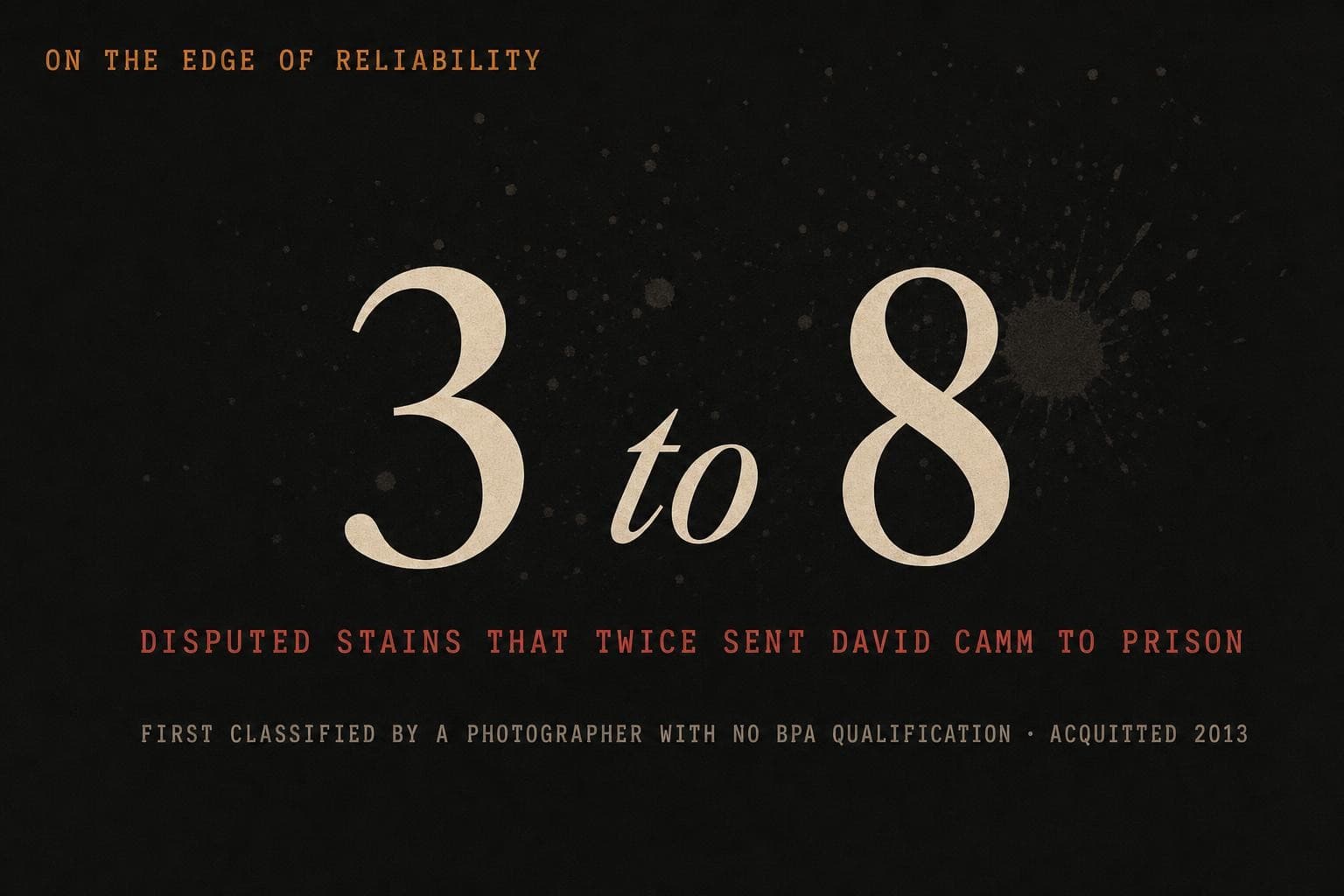
David Camm, a former Indiana state trooper, was convicted twice of murdering his wife and two children, in 2004 and 2006. Bloodstain evidence treated several small stains on his T-shirt as high-velocity impact backspatter showing that he fired the shots. Robert Stites, a crime-scene photographer without bloodstain qualifications, made the initial classification. Later experts disagreed over whether there were three to eight relevant stains. The defence showed that contact transfer while Camm bent over his bleeding daughter also explained the marks. Both convictions were overturned, and he was acquitted in 2013 after another man's DNA and handprint were found.
MacDonell once interpreted two-tone quilt stains as dew; later work attributed them to normal separation of blood cells and serum. In another case, an analyst described material visible in a low-resolution video frame on a victim's palm as gunshot mist despite no documented droplets and wound physics inconsistent with forward spatter. The defendant was convicted of aggravated manslaughter.
Morgan's 2023 registry study identified 33 wrongful convictions involving bloodstain examinations, with case error in nineteen. Thirteen involved testimony error, ten involved an officer of the court and nine involved classification error. Morgan also found that BPA cases reflected the contextual-bias concerns observed experimentally. He describes one conclusion by Dr Henry Lee as speculative and overstating the probative value of the findings.
Admissibility does not itself establish validity. One study found prosecution experts survived challenge about 92% of the time and defence experts 33%. The 2023 amendment to Federal Rule of Evidence 702 directs courts to examine reliable application and overstatement. The recurring lesson is to evaluate alternative mechanisms, state uncertainty and avoid making a categorical event conclusion from a small number of ambiguous stains.
“The number of stains are minimal. I think you're really on the edge of reliability.”
- 01Bloodstain analysis entered courts a century before it was tested. Standardised terminology fixes the words, not the accuracy, and for most of that century no study measured whether analysts get the answer right.
- 02The national black-box study found definite classifications wrong about one time in six, analysts flatly contradicting each other, and error nearly doubling on fabric. A colleague agreeing with you is not proof you are both right.
- 03Many mechanisms produce indistinguishable patterns. Dripped blood reads as impact; a cough reads as gunshot spatter; cloth swipe direction is wrong almost every time. "Consistent with a blow" is not "caused by a blow" unless the alternatives are excluded.
- 04Blood falls on a curve. Straight-line stringing overestimates the source height by up to half, the origin is a region the size of a grapefruit or a basketball, and stain size alone cannot tell the jury the velocity.
- 05You read the blood through the case, and the autopsy report is the strongest mover. An opinion shaped by the case theory is not independent corroboration of it. Point to a blind check, or concede its absence.
- 06Your own standard forbids stating distance, volume or timing from a pattern, and it lets you answer that a pattern cannot be classified. Say the strength of the evidence under two propositions, and never say more than you measured.
- 07The failure cases turned on confident sentences built on a few ambiguous stains, sometimes by people unqualified to read them. Know those cases better than counsel does.
How many stains, and what else?
Your conclusion rests on a small number of stains. Counsel asks you to count them, and to say what else could have made them.
"You've told the jury this is impact spatter. In a well-known case, qualified analysts could not even agree how many relevant stains there were, somewhere between three and eight, and a senior forensic scientist called that the edge of reliability. How many stains are you relying on here, and can you rule out simple contact transfer?"
Still have questions about the research?
Ask anything about the bloodstain pattern analysis literature. The tutor answers from the document itself — and keeps one eye on how it might come up under cross-examination.
- Hicklin, R. A., Winer, K. R., Kish, P. E., Parks, C. L., Chapman, W., Dunagan, K., Richetelli, N., Epstein, E. G., Ausdemore, M. A., & Busey, T. A. (2021). Accuracy and reproducibility of conclusions by forensic bloodstain pattern analysts. Forensic Science International, 325, 110856.
- National Research Council. (2009). Strengthening Forensic Science in the United States: A Path Forward. Washington, DC: The National Academies Press.
- Dror, I. E. (2025). Bloodstain Pattern Analysis (BPA): Validity, reliability, cognitive bias, and error rate. Science & Justice, 65, 101245.
- Hook, E., Fieldhouse, S., Flatman-Fairs, D., & Williams, G. (2024). Bloodstain classification methods: A critical review and a look to the future. Science & Justice, 64, 408–420.
- Taylor, M. C., Laber, T. L., Kish, P. E., Owens, G., & Osborne, N. K. P. (2016). The reliability of pattern classification in bloodstain pattern analysis, part 1: Bloodstain patterns on rigid non-absorbent surfaces. Journal of Forensic Sciences, 61(4), 922–927.
- Taylor, M. C., Laber, T. L., Kish, P. E., Owens, G., & Osborne, N. K. P. (2016). The reliability of pattern classification in bloodstain pattern analysis, part 2: Bloodstain patterns on fabric surfaces. Journal of Forensic Sciences, 61(6), 1461–1466.
- Geoghegan, P. H., Laffra, A. M., Hoogendorp, N. K., Taylor, M. C., & Jermy, M. C. (2017). Experimental measurement of breath exit velocity and expirated bloodstain patterns. International Journal of Legal Medicine, 131, 1193–1201.
- Yuen, S. K. Y., Taylor, M. C., Owens, G., & Elliot, D. A. (2017). The reliability of swipe/wipe classification and directionality determination methods in bloodstain pattern analysis. Journal of Forensic Sciences, 62(4), 1037–1042.
- Behrooz, N., Hulse-Smith, L., & Chandra, S. (2011). An evaluation of the underlying mechanisms of bloodstain pattern analysis error. Journal of Forensic Sciences, 56(5), 1136–1142.
- Laan, N., de Bruin, K. G., Slenter, D., Wilhelm, J., Jermy, M., & Bonn, D. (2015). Bloodstain pattern analysis: Implementation of a fluid dynamic model for position determination of victims. Scientific Reports, 5, 11461.
- Attinger, D., Moore, C., Donaldson, A., Jafari, A., & Stone, H. A. (2013). Fluid dynamics topics in bloodstain pattern analysis: Comparative review and research opportunities. Forensic Science International, 231(1–3), 375–396.
- Connolly, C., Illes, M., & Fraser, J. (2012). Affect of impact angle variations on area of origin determination in bloodstain pattern analysis. Forensic Science International, 223(1–3), 233–240.
- Osborne, N. K. P., Taylor, M. C., Healey, M., & Zajac, R. (2016). Bloodstain pattern classification: Accuracy, effect of contextual information and the role of analyst characteristics. Science & Justice, 56(2), 123–128.
- Osborne, N. K. P., & Taylor, M. C. (2018). Contextual information management: An example of independent-checking in the review of laboratory-based bloodstain pattern analysis. Science & Justice, 58(3), 226–231.
- Dror, I. E., Kukucka, J., Kassin, S. M., & Zapf, P. A. (2018). No one is immune to contextual bias—Not even forensic pathologists. Journal of Applied Research in Memory and Cognition, 7(2), 316–317.
- Edmond, G., et al. (2015). Contextual bias and cross-contamination in the forensic sciences. Law, Probability and Risk, 14(1), 1–25.
- Garrett, B. L., & Neufeld, P. J. (2009). Invalid forensic science testimony and wrongful convictions. Virginia Law Review, 95(1), 1–97.
- Attinger, D., De Brabanter, K., & Champod, C. (2022). Using the likelihood ratio in bloodstain pattern analysis. Journal of Forensic Sciences, 67(1), 33–43.
- Bali, A. S., Edmond, G., Ballantyne, K. N., Kemp, R. I., & Martire, K. A. (2020). Communicating forensic science opinion: An examination of expert reporting practices. Science & Justice, 60(3), 216–224.
- Meijrink, N., van der Scheer, D., & Kokshoorn, B. (2023). The use of Bayesian networks and likelihood ratios in bloodstain pattern analysis. Science & Justice, 63(5), 551–561.
- Organization of Scientific Area Committees for Forensic Science. (2023). Standard for the methodology in bloodstain pattern analysis (OSAC 2022-S-0030).
- Morgan, J. (2023). Wrongful convictions and claims of false or misleading forensic evidence. Journal of Forensic Sciences, 68(3), 908–961.
- De Forest, P. R., Pizzola, P. A., & Kammrath, B. W. (2021). Blood Traces: Interpretation of Deposition and Distribution. Wiley.
- Behrens, M. A., & Trask, A. J. (2024). Federal Rule of Evidence 702: A history and guide to the 2023 amendments. Texas A&M Law Review, 12(1), 43–96.
Digital Forensics: What the Output Does Not Tell You
Counsel is briefed on this literature. Take it into the witness box and practise crime scene reconstruction.