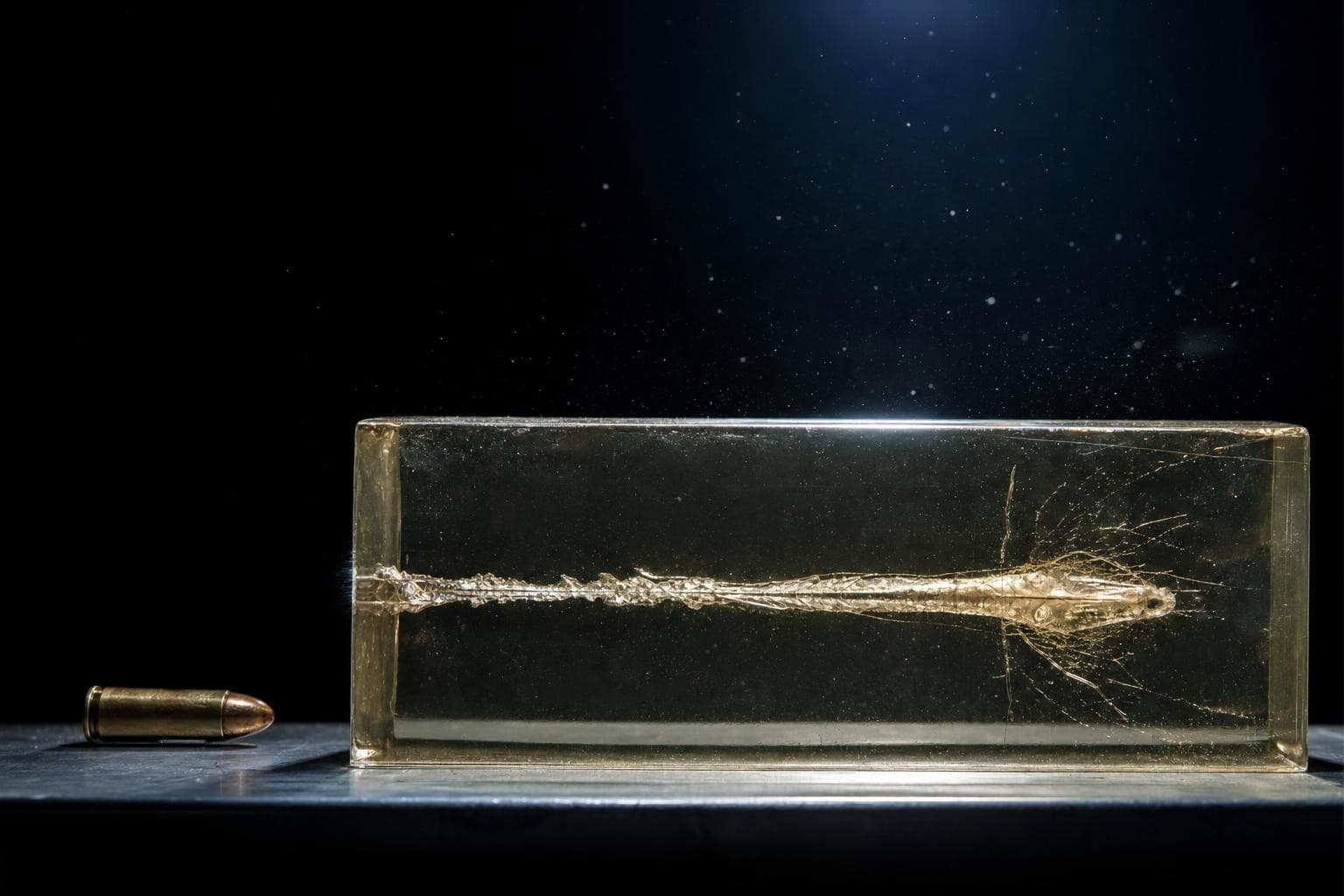
Ballistics & Gunshot Residue: What the Physics and the Particle Can Support
Ballistics and gunshot residue answer a different question from firearm identification: not which gun, but what happened, how far, and who was near a discharge. The measurements are real; the inference laid on top of them often is not. Six sections examine what the physics and the particle can support: the back-inference from a wound, ballistic gelatin as a stand-in for tissue, what a residue particle means, how residue transfers onto people who never fired, and how the conclusion should be worded so it carries the event and not the act.
Two different questions
Firearm and toolmark identification asks a question about a source: which gun fired this cartridge, which tool made this mark. Ballistics and gunshot residue ask a different kind of question, about an event. How far away was the shooter. What path did the bullet take. What did it do inside the body. Who was near a discharge. These are activity-level questions, closer to reconstructing a scene than to matching two marks, and the honest strength of an answer, and the way it fails, are different in kind.
A source claim overreaches when it names one gun to the exclusion of every other. An event claim overreaches in a quieter way: it takes a real, careful measurement and carries it past what it can bear, into a story about who did what and from where.
That is the pattern in both wings of this work. A wound is measured to the millimetre. A gelatin block is penetrated to a calibrated depth. A residue particle is characterised down to its elements. Each measurement is real, and often precise. The trouble comes when the number is asked to answer a question it was never able to reach: where the shooter stood, what the wound proves, whether this person fired the gun.
The measurement is not the weak point. The inference laid on top of it is. Gunshot residue makes the gap explicit, because the people who run the test say so themselves. The analysis finds micro-particles and classifies them. It does not establish that a particular person discharged a firearm, and the field's own leaders have said as much for decades.
“None of what we do can establish if anybody discharged a firearm”
This reading follows the physics and then the transfer. First the wound and the block behind it: how far a terminal-ballistics reconstruction can honestly run backwards from an injury, and how much weight ballistic gelatin can carry as a stand-in for tissue. Then the residue: what a single particle actually means, how it moves onto people who never fired a shot, and how the conclusion should be worded so it reports the event and not the act. Throughout, the aim is the same as any honest testimony: state what the trace supports, state the assumptions, and stop there.
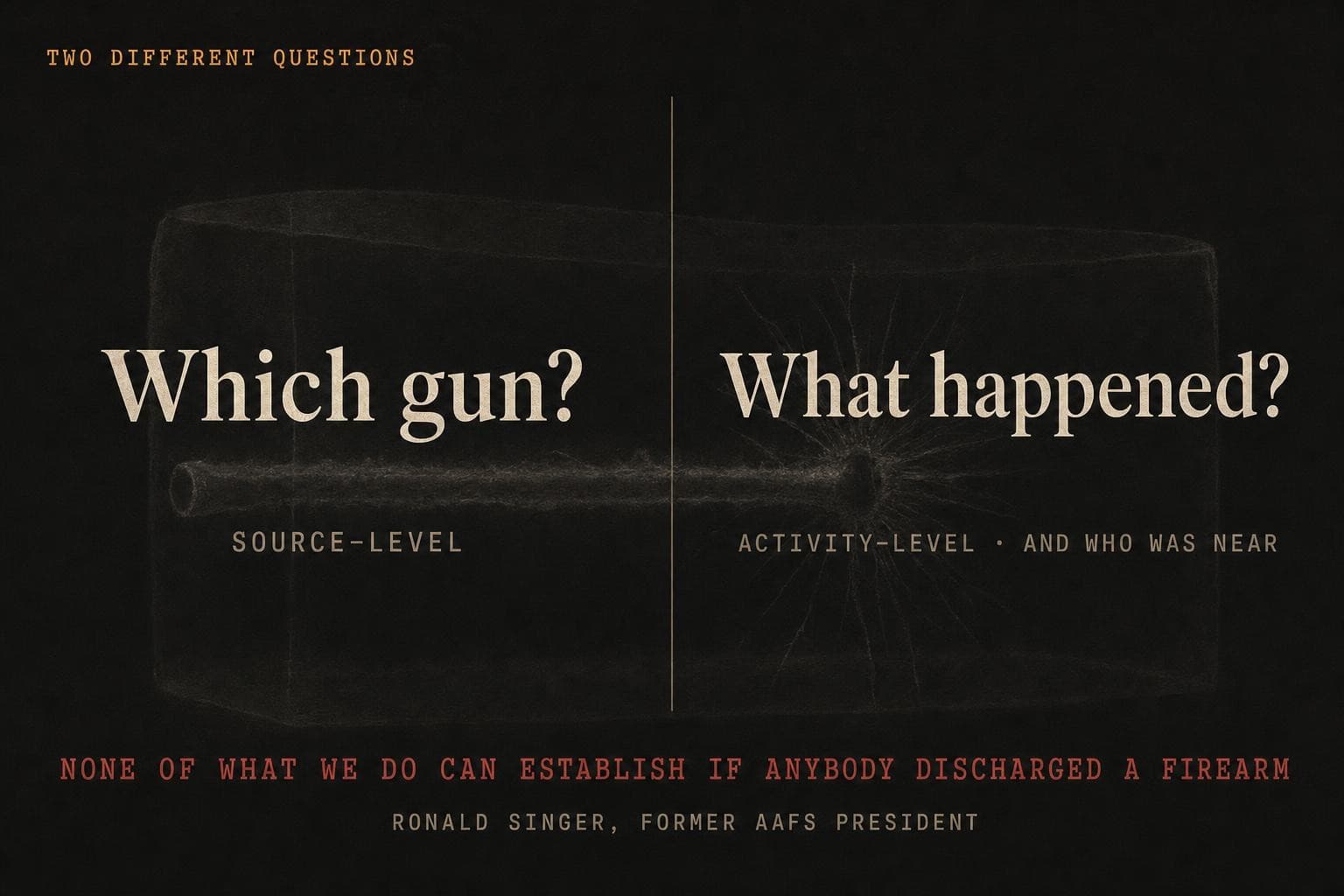
Which question are you answering?
You have summarised your findings as showing that the defendant shot the victim.
"I put it to you that your tests speak to an event, a discharge, a trajectory, some residue, and not to the act of a particular person pulling a trigger. And that even on the event, your answers come with real limits you have not troubled this jury with. Your evidence is narrower than the conclusion you have offered, isn't it?"
Wound ballistics and the back-inference limit
Reconstruction from a wound runs backwards, from the injury to the shot, and the physics bounds how far back it can go. Start with the tissue the bullet meets. Bone fractures at a striking velocity of only about 200 feet per second, and experimental work has perforated bone at speeds as low as 99 metres per second, near a reported human threshold around 61. Bone is easy to break, and once broken it becomes its own projectile: displaced bone spicules travel forward and cause damage further along the track. So the wound is not a clean recording of one object's passage. Some of what an examiner sees downstream was done by shattered bone, not by the bullet, and the two cannot be neatly separated.
Now the two things a wound is most often asked to yield: the calibre and the position. Neither reads out cleanly. Measuring cranial entrance wounds of known calibre, one study found mean diameters of about 0.30 inch for a .22, 0.28 for a .25 and 0.46 for a .38, but the ranges overlap, a .38 could not be told from a .22 or a .25 at the margins, and many calibres fire a bullet of identical diameter, a .38 and a .357 among them. Wounds were usually larger than the bullet, sometimes smaller. And the bullet does not fly nose-first and stable through tissue: it yaws and tumbles, so the wound depends on where along the track the yaw begins. The average wound profile appears in only about seven cases in ten. The word velocity, and the phrase kinetic energy, say little about the size or location of the disruption; bullet construction drives severity far more than speed.
“it may never be possible to identify the specific caliber from a single measurement of the defect.”
Position is bounded the same way. Fired through a body's depth of tissue, a rifle bullet can deflect sharply: minimal deflection over the first few centimetres, but up to twenty-five or thirty degrees once it has crossed twenty-odd centimetres and begun to fragment, after which the direction becomes erratic. A careful reconstruction attaches an error cone of roughly thirteen degrees around the back-projected line, not a single ray to a spot on the floor. And the raw material is often thin: in one review, adequate wound descriptions were recorded in under three per cent of cases. None of this makes wound ballistics useless. It supports coarse, honest statements: that a wound is consistent with a larger rather than a smaller calibre, the direction of fire from bevelling, a trajectory over a short early stretch of track, and a reconstruction reported as a bracketed range. What it will not support is a precise calibre, or a precise place the shooter stood, offered to the jury as fact.
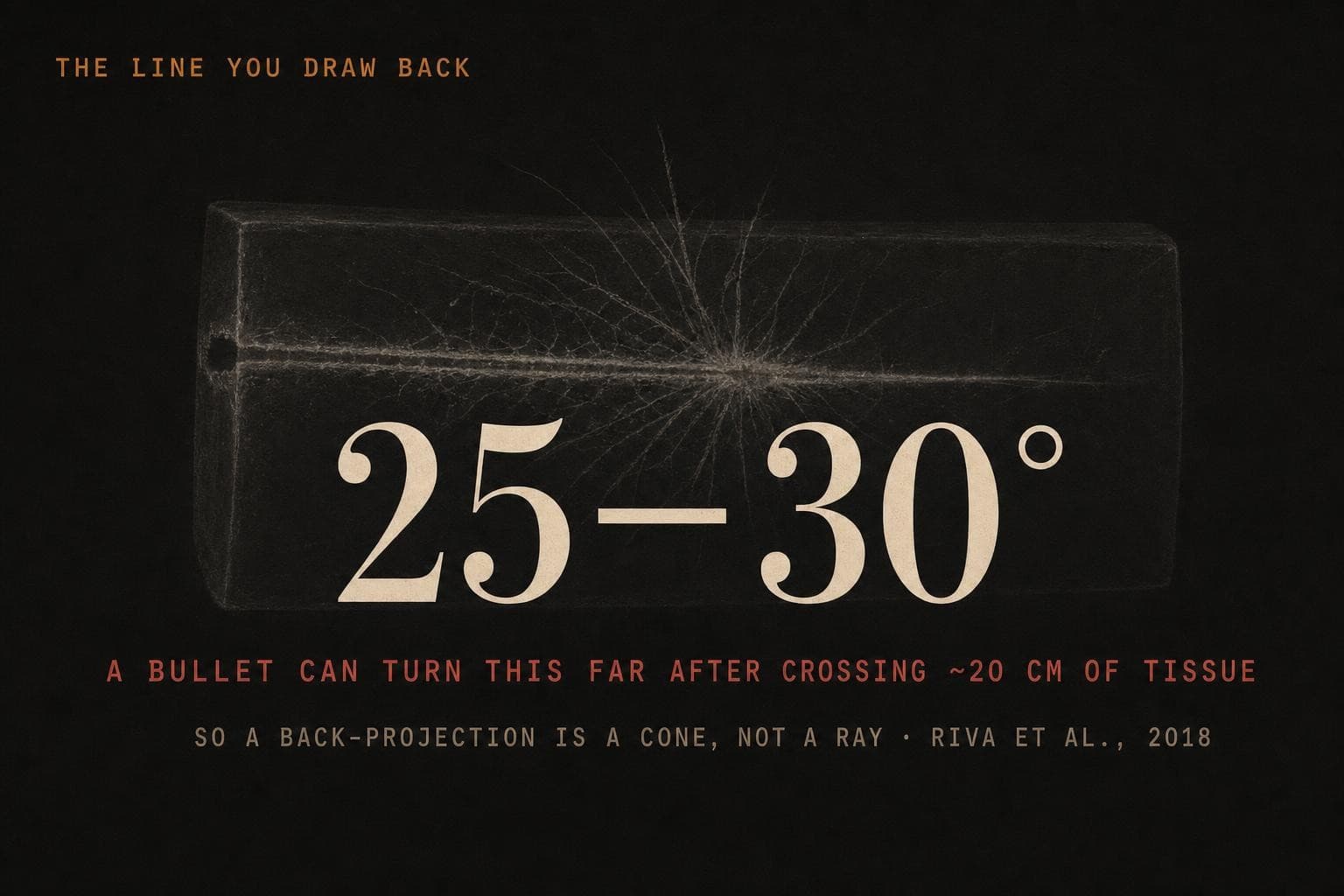
A line, or a cone?
You told the jury the shot was fired from a particular position, and hinted at a calibre.
"I put it to you that by the time this bullet had passed through the better part of a body it could have turned and veered by twenty degrees or more, so the straight line you drew back to where my client supposedly stood is, at best, a guess dressed up as geometry. And the size of the wound cannot even tell us the calibre, can it?"
Ballistic gelatin and the tissue it stands in for
Behind many terminal-ballistics claims sits a block of ballistic gelatin, used as a stand-in for soft tissue. Its whole appeal is that it is standardised. The accepted calibration is specific: a 4.5 millimetre steel sphere fired at about 180 metres per second into ten per cent gelatin at four degrees should penetrate roughly 85 millimetres, the same depth reached in pig muscle. That single equivalence, gelatin to pork, is the entire empirical bridge from the block to living tissue. Within its own terms the medium is genuinely good: reproducible to a couple of millimetres across dozens of shots, transparent enough to film the passing bullet, and density-matched to muscle.
The limits sit close to the strengths. Results are sensitive to how the block is made. The same recipe can penetrate about 50 millimetres cured at ten degrees and about 80 at twenty, a swing of more than half from temperature and curing alone. There is no agreed international standard: different laboratories use different calibration curves and different projectiles, and a depth from one is not comparable to a depth from another. Change the sphere size and the same velocity drives it twice as deep. A penetration figure quoted without the calibration record for that block, on that day, is a number without a yardstick.
“it is homogeneous and cannot replicate the heterogeneous nature of human tissue. Therefore at best, it can only be considered a soft tissue simulant.”
And the block is not a body. Gelatin is homogeneous; a body is skin over fat over muscle over bone, threaded with vessels and organs of different elasticity, and a bullet does not know it has left the gel. The validation, moreover, is against animal muscle: as recently as 2024 the field conceded there is no comparative data from human subjects. The feature juries find most vivid, the temporary cavity, is the least transferable of all, drawn by the method's founder as an approximation of a maximum and dependent on local anatomy; in one 2024 study two accepted methods measuring the same block disagreed with each other. The honest use is comparative. Gelatin can show that one load penetrates further than another under identical conditions, and it can exclude. Standardisation buys comparability, not a body, and a gel result should be offered as what it is: a calibrated comparison in a simulant, not a measurement of the wound in the deceased.
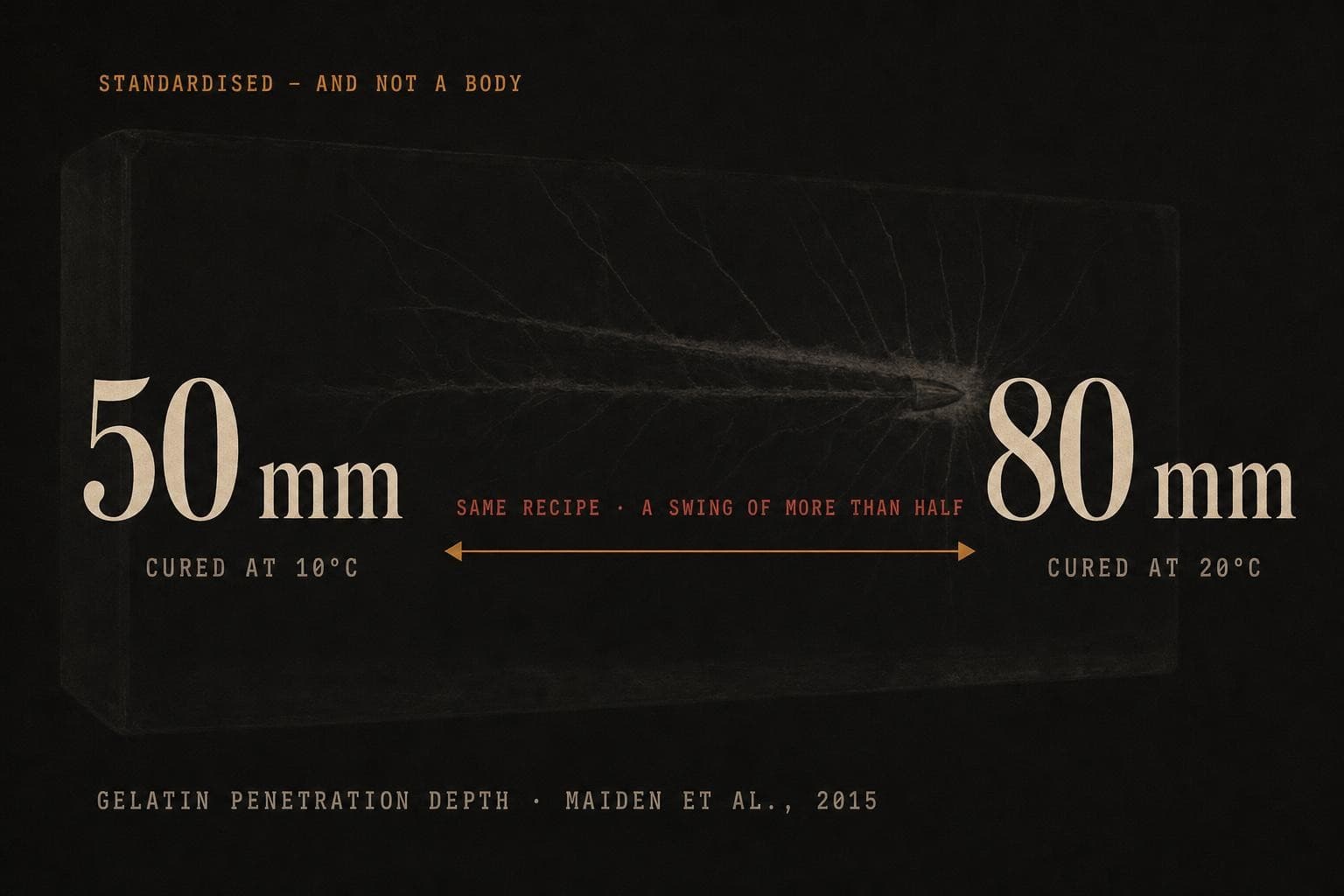
Jelly is not a body
You relied on a ballistic gelatin test to tell the jury what the bullet did in the body.
"I put it to you that ballistic gelatin is one uniform substance, whereas the body you say it represents is skin over fat over muscle over bone; that the only tissue it was ever measured against is pig muscle; and that get the temperature or the curing wrong and the very same recipe reads fifty millimetres or eighty. So your block cannot tell this jury what happened in the deceased, can it?"
What a gunshot-residue particle means
Gunshot residue analysis looks at micro-particles under a scanning electron microscope and sorts them by their elemental make-up. The distinction that decides most cases is between particles characteristic of a firearm discharge and particles merely consistent with one. The list treated as characteristic, coming only from primer, is short: essentially a lead-antimony-barium composition, and a couple of close relatives. Everything else points toward a firearm without excluding other origins. Classification rests on composition, on a permitted list of accompanying elements, and on the particle's molten, spheroidal shape.
The problem is that the characteristic composition is not unique to guns. The same lead-antimony-barium particles come off worn car brake linings, where the disc runs hotter than fifteen hundred degrees; off spent fireworks; and off cartridge-operated tools used in construction. For lead-free ammunition the signature shifts to titanium and zinc, which also define ordinary paint pigment. In several of these cases the only thing separating a firearm particle from an innocent one is its shape, and only for the spherical particles. So chemistry alone does not carry the conclusion the court wants.
“the presence of GSR on an individual's hand does not necessarily prove that the person discharged or handled a firearm.”
Two further facts keep the honest examiner cautious. First, casework rests on almost nothing: in most positive samples only a handful of particles are found, and in a large share only a single particle, and when only a few are present the microscope search itself misses them a substantial fraction of the time. Second, the true characteristic particle is genuinely rare in the general population, which sounds reassuring until transfer is added: a person who only stood nearby, or shook a hand, or picked the gun up afterwards can carry the same particles. The defensible conclusion is a statement about the particle, not the person: residue of a composition and morphology characteristic of primer discharge was present, and classified accordingly. The leap to this person fired a gun is not something a particle can support.
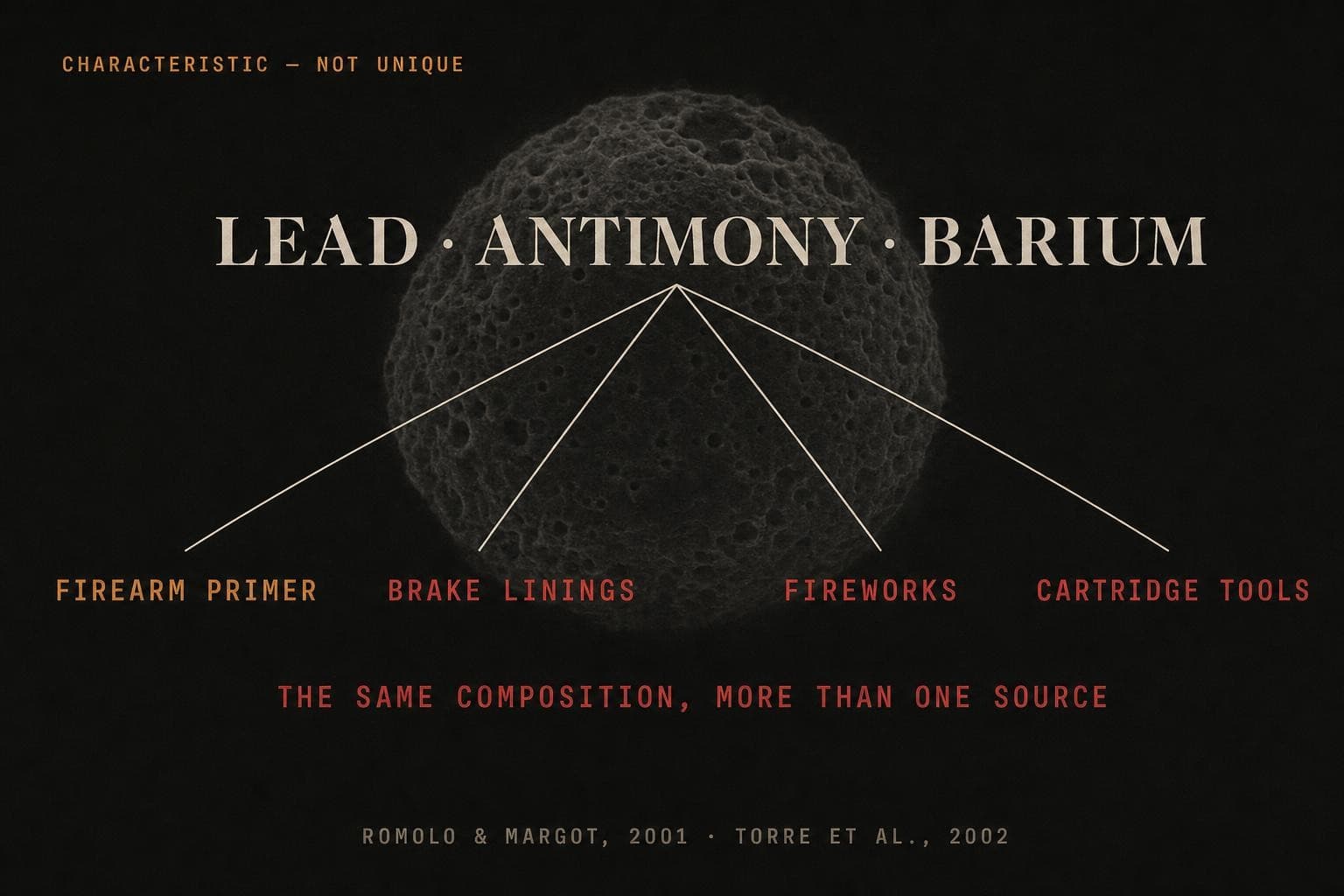
The same particle, three sources
You told the jury the particles on the defendant were characteristic of a firearm discharge.
"I put it to you that the particle you have called characteristic of a firearm, lead, antimony and barium, is exactly the particle that comes off a worn car brake lining, where the disc runs hotter than fifteen hundred degrees, and off spent fireworks. So its chemistry alone cannot tell this court a gun was fired, can it?"
Secondary transfer and lead-free ammunition
The single most important fact about gunshot residue in a courtroom is that it moves. Presence on a person's hands does not establish that the person fired, because residue transfers from surface to surface and hand to hand. The clearest data come from the police themselves. In one Australian study, firearms-carrying officers carried characteristic residue at about eight per cent, against roughly a third of one per cent in the general population, and three-quarters carried at least a particle consistent with it. Simply receiving a firearm at the start of a shift left two-thirds of officers with at least one particle, and some with more than a hundred. In a staged arrest, a median of about a quarter of an officer's particles transferred to the person being restrained in a few minutes of contact.
Transfer does not stop at one step. In a controlled study, residue reached a person two handshakes removed from the shooter, and did so more efficiently than the first transfer, leaving a dozen or more particles on someone who never touched the gun or the shooter. Bystanders standing behind the shooter picked up comparable numbers, and large particles transferred along with small ones, so particle size does not rescue the inference. An arrest is exactly the scenario that manufactures this problem: an armed officer, already carrying residue, takes hold of a suspect's hands.
“bystanders may be exposed to just as much, if not more, GSR than the shooter in an indoor setting”
Lead-free ammunition removes the classic signature altogether. Non-toxic primers use titanium and zinc rather than lead, antimony and barium, so the particles the test hunts for may simply be absent, and those metals have many more everyday sources. Where lead-antimony-barium particles do appear after a lead-free round, they can be old residue left in the barrel by earlier conventional firing, a memory effect rather than proof of this shot. The fair counter, which an honest examiner should also give, is that transfer is not unmanageable: with control sampling of the arresting officers, gloves, one suspect per officer, and, in some jurisdictions, tagged police ammunition, contamination can be detected and bounded. The danger is greatest precisely where the count is small and the arrest was ordinary, and that is exactly the case in which consistent with having discharged a firearm should not be said.
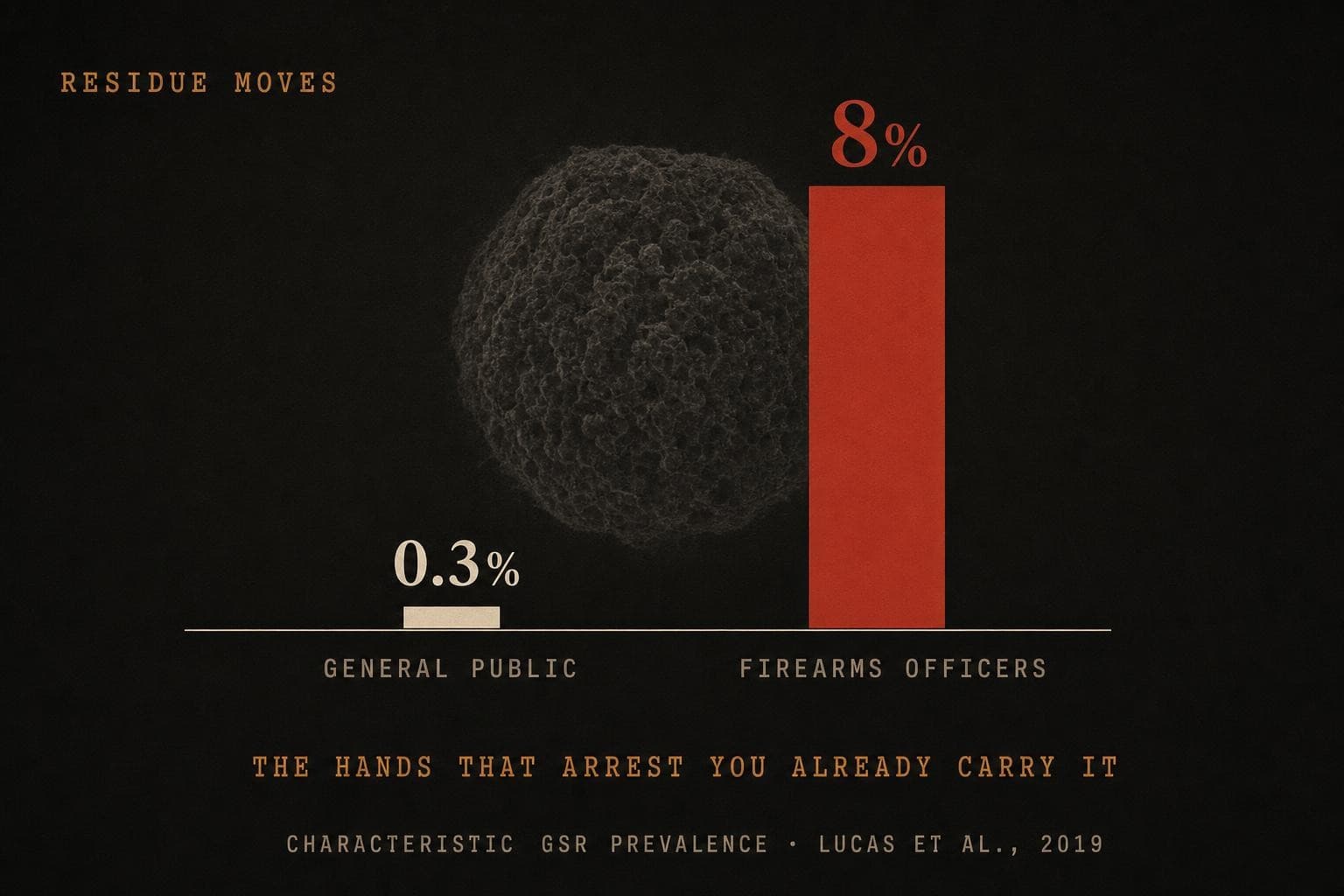
How did it get there?
You told the jury that residue on the defendant's hands showed he had fired a gun.
"I put it to you that gunshot residue moves. It travels from an armed officer's hands, from the back of a patrol car, from a holding-cell bench, from a handshake, onto the hands of a person who never touched a firearm. And that the very officers who arrested my client carry this residue at many times the rate of the ordinary public. So its presence on his hands tells this jury nothing about whether he fired, does it?"
Source, activity, and how to say it
How a ballistics or residue conclusion is worded is where the overclaim lives, and the fault line has a name. A gunshot-residue positive is a source-level finding: it answers whether the particles are residue. The question the court cares about is activity-level: did this person discharge a firearm. The discipline's standard framework was built to answer the first question, and reaching the second requires transfer, persistence and background contamination to be weighed under competing accounts of the event. That step is often skipped. In one survey, a substantial share of laboratories would report a single characteristic particle as a positive, with none of that evaluation attached.
When the evaluation is done properly, the reported strength turns out to depend on an assumption the analyst brings to it. Model the same particle count against a low assumed background and the evidence strongly favours the prosecution; assume a higher background and the very same particles favour the defence, or say nothing at all. The number of particles does not correlate well with being the actual shooter. And building the innocent explanation directly into the proposition, contaminated by the arresting officer, collapses the calculation to a likelihood ratio of about one; contamination has to be handled as a competing account of the event, not smuggled into the hypothesis. The weight of the evidence is not a fixed property of the particle. It is a function of assumptions that should be stated out loud.
“an inevitable degree of arbitrariness will remain in the probabilities derived from the observed GSR data even when analyzed by an experienced forensic scientist”
Ballistics and gunshot-residue conclusions fail most often in the wording. Each phrase below overstates what the physics or the particle can carry; the alternative keeps the sentence inside what the measurement can support.
There is a documented cost to getting this wrong. Gunshot residue has featured in wrongful convictions, and the wording consistent with having discharged a firearm has done work in front of juries that the science cannot support. The honest report states what the residue can carry: that a person was in the environment of a discharge, or in contact with a fired weapon or a contaminated surface, expressed as a likelihood ratio under stated, competing propositions. The same discipline governs the physics. A wound or a gelatin result supports a bounded, error-bracketed reconstruction, not a precise account of range, calibre and position. In both wings the rule is the same: report the event the measurement can support, name the assumptions, and do not let precision of measurement stand in for proof of the act.
- 01Ballistics and residue answer event questions, not which gun. The overclaim is turning a real measurement, a wound, a gel depth, a particle, into a story about who did what and from where.
- 02A wound cannot name a calibre: the ranges overlap and many calibres share a diameter. Once a bullet has crossed a body it may have deflected twenty degrees or more and fragmented, so back-projection carries a stated error cone. Report the cone, not the ray.
- 03Ballistic gelatin is a standardised simulant validated against pig muscle, not human tissue. There is no agreed standard and results swing with temperature and cure. It buys comparability, not a body, so quote a depth only with its calibration.
- 04A particle characteristic of primer, lead-antimony-barium, also comes from brake linings, fireworks and tools; for lead-free ammunition the signature is titanium and zinc, which also defines paint. Morphology and context, not chemistry alone, carry the weight.
- 05Residue transfers, from an armed officer, a patrol car, a cell or a handshake, onto people who never fired; a bystander can carry as much as the shooter, and casework often rests on a single particle a search can miss. Presence is not proof of firing.
- 06A residue positive is source-level; the court's question is activity-level. The reported strength depends on an assumption about background contamination that can move the likelihood ratio from conclusive to worthless, so state the assumptions and frame competing accounts rather than smuggling the innocent one in.
- 07Say what the residue and the wound can support, that someone was in a shooting environment, that a reconstruction falls within a bracketed range, not that this person fired or that the shot came from an exact spot. Precision of measurement is not proof of the event.
What if the background were higher?
You gave the jury a strong opinion on the weight of the residue evidence.
"I put it to you that the weight you placed on this residue rests entirely on an assumption you made about how much background residue was already about. Assume a little more, and the very same particles point away from my client rather than toward him. You did not tell the jury the answer swings on your own assumption, did you?"
Still have questions about the research?
Ask anything about the ballistics and gunshot residue literature. The tutor answers from the document itself — and keeps one eye on how it might come up under cross-examination.
- Dalby, O., Butler, D., & Birkett, J. W. (2010). Analysis of gunshot residue and associated materials — A review. Journal of Forensic Sciences, 55(4), 924–943.
- Romolo, F. S., & Margot, P. (2001). Identification of gunshot residue: A critical review. Forensic Science International, 119(2), 195–211.
- Torre, C., Mattutino, G., Vasino, A., & Robino, C. (2002). Brake linings: A source of non-GSR particles containing lead, barium, and antimony. Journal of Forensic Sciences, 47(3), 494–504.
- Brożek-Mucha, Z. (2014). On the prevalence of gunshot residue in selected populations — An empirical study performed with SEM-EDX analysis. Forensic Science International, 237, 46–52.
- Gunaratnam, L., & Himberg, K. (1994). The identification of gunshot residue particles from lead-free Sintox ammunition. Journal of Forensic Sciences, 39(2), 532–536.
- Owens, M. (1990). A statistical model for the size of a gunshot residue search area: A correction. Journal of Forensic Sciences, 35(3), 698–705.
- French, J., Morgan, R., & Davy, J. (2014). The secondary transfer of gunshot residue: An experimental investigation carried out with SEM-EDX analysis. X-Ray Spectrometry, 43(1), 56–61.
- French, J., & Morgan, R. (2015). An experimental investigation of the indirect transfer and deposition of gunshot residue. Forensic Science International, 247, 14–17.
- Lucas, N., Cook, M., Kirkbride, K. P., & Kobus, H. (2019). Gunshot residue background on police officers: Considerations for secondary transfer in casework. Forensic Science International, 297, 293–301.
- Maitre, M., Kirkbride, K. P., Horder, M., Roux, C., & Beavis, A. (2017). Current perspectives in the interpretation of gunshot residues in forensic science: A review. Forensic Science International, 270, 1–11.
- Charles, S., Dodier, T., Kaindl, M., Kloten, K., Larsson, M., Neimke, D., et al. (2020). Round robin test for the composition of a proficiency test material for gunshot residue analysis. Forensic Science International, 309, 110183.
- Charlot, M., Kukurin, K., van der Ham, K., & Stamouli, A. (2026). Gunshot residue at activity level and the transition to non-traditional ammunition: A review. Forensic Science International, 378, 112682.
- Gauriot, R., Gunaratnam, L., Moroni, R., Reinikainen, T., & Corander, J. (2013). Statistical challenges in the quantification of gunshot residue evidence. Journal of Forensic Sciences, 58(5), 1149–1155.
- Biedermann, A., Bozza, S., & Taroni, F. (2009). Probabilistic evidential assessment of gunshot residue particle evidence (Part I). Forensic Science International, 191(1–3), 24–35.
- Amato, J. J., Syracuse, D., Seaver, P. R., & Rich, N. (1989). Bone as a secondary missile in high-velocity gunshot wounds. Journal of Trauma, 29(5), 609–612.
- Berryman, H. E., Smith, O. C., & Symes, S. A. (1995). Diameter of cranial gunshot wounds as a function of bullet caliber. Journal of Forensic Sciences, 40(5), 751–754.
- Caister, A. J., Carr, D. J., Campbell, P. D., Brock, F., & Breeze, J. (2020). The effect of impact velocity on the fracture of isolated bone by fragment simulating projectiles. International Journal of Legal Medicine, 134(4), 1387–1393.
- Fackler, M. L., Bellamy, R. F., & Malinowski, J. A. (1988). The wound profile: Illustration of the missile-tissue interaction. Journal of Trauma, 28(1 Suppl), S21–S29.
- Fackler, M. L. (1995). Gunshot wound review. Techniques in Orthopaedics, 10(3), 163–170.
- Riva, F., Mattijssen, E. J. A. T., & Kerkhoff, W. (2018). Deviation of bullets fired through gelatine: A reconstruction consideration. Forensic Science International, 291, 199–206.
- Jussila, J. (2004). Preparing ballistic gelatine — Review and proposal for a standard method. Forensic Science International, 141(2–3), 91–98.
- Maiden, N. R., Fisk, W., Wachsberger, C., & Byard, R. W. (2015). Ballistics ordnance gelatine — How different concentrations, temperatures and curing times affect calibration results. Journal of Forensic and Legal Medicine, 34, 145–150.
- Pullen, N., Kieser, D. C., & Hooper, G. (2020). Ballistic gelatin calibration standardisation. BMJ Military Health (Epub ahead of print).
- Bir, C., Menkara, A., Villalta, J., Bodo, M., Roth, N., & Sherman, D. (2024). A comparison of gelatine surrogates for wound track assessment. International Journal of Legal Medicine, 138(5), 2003–2013.
- Haag, L. C. (1995). Book review of Sellier & Kneubuehl, Wound Ballistics and the Scientific Background. American Journal of Forensic Medicine and Pathology, 16(4), 355.
DNA Evidence: What the Match Can and Cannot Support
Counsel is briefed on this literature. Take it into the witness box and practise firearms, ballistics & GSR.